The University of Pisa obtained the periodic accreditation of its structures and of the Study Programmes from the Academic Year 2019/20 to 2023/24 with Ministerial Decree no. 227 of 19 June 2020..
The Periodic Accreditation visit of the University of Pisa and its Study programmes was held from 11 to 15 March 2019 (see the ANVUR Final Report, approved by Resolution of the ANVUR Governing Council no. 294 of 17 December 2019).
The Periodic Accreditation Process is a key verification phase designed to ensure that the quality standards established during the initial accreditation continue to be met and that the QA requirements set out in Annex C of Ministerial Decree (D.M.) 1154/2021 are fulfilled.
During the periodic accreditation, several aspects are taken into account, including:
Analysis of the data contained in the Annual Report of the University Evaluation Board (NdV) and of the results of the monitoring and quality control activities relating to the teaching and research activities carried out by all the subjects involved in the University Quality System;
Analysis of the data contained in the CPDS annual report.
Evaluation of the information contained in the Study Programme Annual Form (SUA-CdS) and in the Review Reports,
Evaluation of the information included in the Departmental Research Annual Form (SUA-RD) and in the Third Mission/Social Impact Form (SUA-TM),
Evaluation of the indicators established for periodic evaluation.
The audits are conducted by an Evaluation Expert Panel (CEV) and cover the University as a whole, as well as a selection of Study Programmes, PhD Programmes and Departments identified by ANVUR so as to ensure adequate representation of the different disciplinary areas, types of Study Programmes (three-year, master’s and single cycle; Conventional / Blended / Predominantly or Fully Remote) and, where applicable, decentralized structures.
The selection also takes into account, for Study Programmes (CdS), the performance measured through indicators relating to students’ careers, and for Departments, the results of the most recent Research Quality Evaluation (VQR).
In addition, consideration is given to the outcomes of previous visits, to the follow-up activities implemented to address recommendations and/or conditions, and to the evaluations conducted by ANVUR for the extension of accreditation of Study Programmes after the third year following the issue of the accreditation decree by the MUR (Ministry of University and Research).
The number of Study Programmes, PhD Programmes, and Departments identified varies based on the number of Study Programmes active in the academic year preceding the visit and follows a scheme established by ANVUR.
In the case of the University of Pisa, the 2019 visit involved1twelve Study Programmes and three Departments.
Departments are selected from those hosting at least one Study Programme subject to the visit.
PhD Programmes are usually selected from among those offered within the Departments chosen for the visit.
Phases of the process and the Evaluation Expert Panel (CEV)
Specifically, the Periodic Accreditation process is divided into four phases:
Documentary Analysis
Institutional Visit (conducted remotely for Study Programmes and PhD Programmes, and on site for the University’s structures and Departments)
Report of the CEV
ANVUR Periodic Accreditation Report
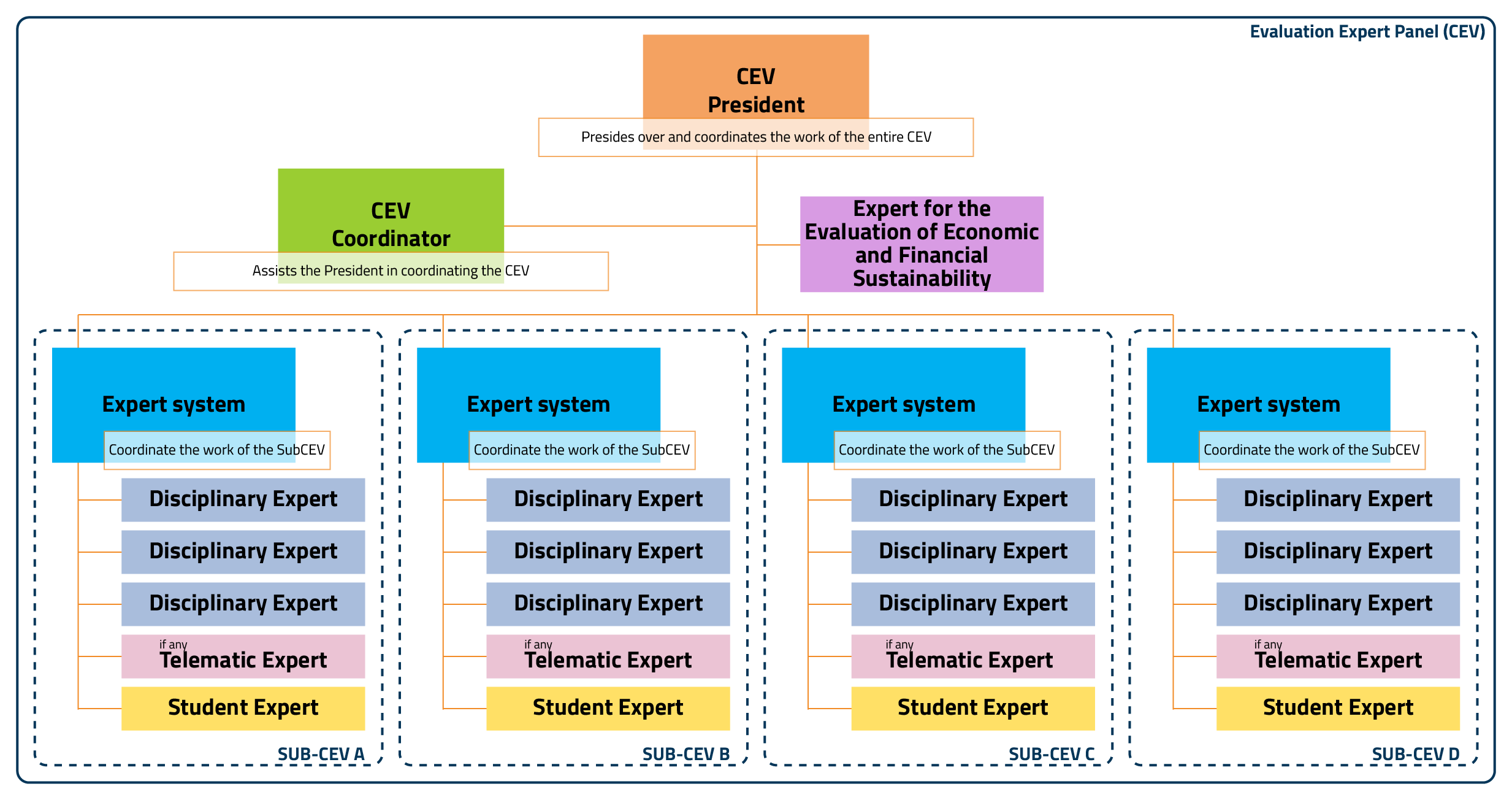
The Evaluation Expert Panel (CEV) participating in the Accreditation process is composed of a President2, a Coordinator3, System Experts4, an Expert for the evaluation of Economic and Financial Sustainability5, Disciplinary Experts6, Student Experts7, all of whom are registered in the AVA Register of Experts.
In cases where the assessment also includes a Study Programme delivered predominantly or entirely online, the CEV is supplemented by Telematic expert8.
The members of the Evaluation Expert Panel (CEV)9, each according to their respective roles, carry out the following tasks:
conduct the examination remotely
participate in the on-site visit for its entire duration
contribute, within their field of competence, to the drafting of the final report, and collectively approve its contents.
Based on the number of Study Programmes being evaluated, the Evaluation Expert Panel (CEV) is organized into multiple subpanel (sub-CEV), allowing several Study Programmes to be visited on the same day.
As a rule, the number of sub-CEV corresponds to the number of PhD Programmes/Departments under evaluation. In the case of the visit to the University of Pisa, the CEV will be divided into four sub-CEV.
The documentary analysis phase is carried out remotely, through a careful review of the University’s website and of the documentation made available by the institution.
For this purpose, the University prepares a Self-Evaluation Report, providing a comprehensive and systematic analysis of the processes and activities implemented, with specific reference to each Aspect to be Considered under every Point of Attention identified in the accreditation framework.
The documentary review continues until the remote visits of the Study Programmes and PhD Programmes, with the production of the first results.
As a rule, the on-site visit takes place within two weeks thereafter, marking the conclusion of the institutional review phase.
The assessments formulated during the two remote phases, supplemented by the evidence gathered during the on-site visit, form the basis for the drafting of the Preliminary Report by the Evaluation Expert Panel (CEV).
The Preliminary Report is then submitted to ANVUR and subsequently sent to the University, which may present its counterarguments.
The CEV then prepares its Responses to the University’s Counterarguments, with the possibility of revising the Final Report accordingly.
Once these iterations are completed, the Final Report is approved and submitted to ANVUR for the preparation of the Periodic Accreditation Report.
The formulation of the judgment
Through the verification of Quality Assurance (QA) requirements, the visits contribute to determining whether the University’s Governing Bodies have implemented an adequate QA System.
In the judgment formulation phase, consideration is given to the results achieved by the University with respect to the processes and activities identified in the QA requirements, for each evaluation domain, for every aspect to be considered and its related points of attention.
The results are measured through qualitative or quantitative indicators, which make it possible to classify each the Point of Attention according to four different levels of satisfaction (Fully Satisfactory, Satisfactory, Partially Satisfactory or Not Satisfactory).
The expressed judgment may be supplemented by a report of “good practice”, “recommendation” or “condition”, as appropriate and duly justified.
The Report expresses ANVUR’s overall judgment regarding the Periodic Accreditation of the Institution, according to the following scale:
LEVEL
ACCREDITATION
METRICS
VALIDITY
A
Fully satisfactory
When at least 75% of the University’s points of attention have been assessed as “Fully satisfactory”
Five-year validity, with an intermediate verification of the Study Programmes at the end of the third year.
B
Satisfactory
When at least 50% of the study programme points of attention have received the “Satisfactory” or “Fully Satisfactory” assessment.
Five-year validity, with an intermediate verification of the University and of the Study Programmes at the end of the third year.
C
Conditional
When between 25% and 50% of the university’s points of attention have received “Satisfactory” or “Fully satisfactory,” and no more than 50% have been assessed as “Not Satisfactory”.
In this case, critical issues are identified, which must be resolved within the deadline established at the time of the assessment.
• In the event that the identified critical issues are resolved, the accreditation period is extended by an additional 4 or 3 years;
• Failure to resolve the critical issues results, depending on their severity, in either the confirmation of the conditional accreditation, or to the revocation of the University’s accreditation;
• In any case, the “conditional accreditation” status may not last for more than 4 years, after which ANVUR may propose the closure of the University.
D
Not Satisfactory
When at least 50% of the university’s points of attention have been assessed as “Not satisfactory”.
Revocation of the University’s accreditation.
The University’s periodic accreditation involves the periodic accreditation of all its Study Programmes for a maximum duration of three years, except for those that have received a negative assessment.
For each Study Programme, the University receives an Evaluation Sheet, which also includes an assessment by category, and an analysis of strengths and areas for improvement associated with the specific points of attention within the CdS (Study Programmes).
In the case of a negative assessment of the Study Programme, the ANVUR will propose to the Ministry the revocation of its accreditation (Ministerial Decree no. 1154/2021). In this case, no new cohorts of that Study Programme may be activated (thus allowing enrolled students to complete their studies), without prejudice to the possibility of re-submitting the programme for new activation following a comprehensive revision of the educational programme.
If critical issues are identified, or upon notification by the Ministry, ANVUR may order an in-depth assessment of the Study Programme.
If the outcome is positive, the duration of the CdS accreditation is automatically extended until the expiry of the University accreditation; otherwise, the accreditation is revoked, and the Study Programme is closed.
The ANVUR Report, together with the proposal and the accreditation judgment is transmitted by ANVUR to the MUR and accreditation is then granted by ministerial decree.
ANVUR publishes the CEV Final Report and the AP Report on its institutional website.
The University Evaluation Board (NdV) plays a fundamental role in the accreditation process. It is responsible for assessing the improvement actions undertaken to address the recommendations and conditions set by the CEV (Article 5 of Ministerial Decree no. 1154/2021), with reference to the requirements concerning the Structures, Study Programmes, PhD Programmes, and Departments under evaluation. The monitoring activity carried out by the NdV is documented through Verification Sheets, accompanied references to the relevant documentary sources.
Study Programmes and Departments Visited in 2019: • Degree Programme in Cultural Heritage Studies [L-1] • Degree Programme in Chemical Engineering [L-9] • Degree Programme in Foreign Languages and Literatures [L-11] • Degree Programme in Viticulture and Enology [L-26] • Degree Programme in Economics and Commerce [L-33] • Degree Programme in Energy Engineering [LM-30] • Degree Programme in International Studies [LM-52] • Degree Programme in Chemistry [LM-54] • Degree Programme in Environmental Sciences [LM-75] • Degree Programme in Law (Naval Academy) [LMG/01] • Degree Programme in Medicine and Surgery [LM-41] • Degree Programme in Veterinary Medicine [LM-42] • Department of Civilisations and Forms of Knowledge • Department of Energy, Systems, Territory and Construction Engineering • Department of Translational Research and New Surgical and Medical Technologies↩
The President of the CEV ensures the proper conduct of all assessment procedures and their compliance with ANVUR models, and defines the drafting of the CEV Report, which they prepare with the support of the Coordinator;
They formulate proposals for the revision, correction and integration of the Expert Evaluation Sheets;
They coordinate meetings with the Representatives of the Structures during the institutional visit and participates, on a rotational basis, in the visits to the Study Programmes, PhD Programmes and Departments, presenting, at the conclusion of the on-site visit and in a concise presentation, the main strengths and areas for improvement identified during the evaluation.
The President is selected from the AVA Register of Experts – System Expert Profile, on the basis of their previous experience in the field of accreditation and evaluation.↩
The Coordinator assists the President throughout all phases of the accreditation process, ensuring, in particular, clear and effective communication within the CEV and compliance with the established schedule.
They verify that the entire accreditation process is conducted in accordance with these Guidelines and as established by the CEV in the visit programme.
They ensures that the final assessments formulated by the Panel are consistent, homogeneous, and supported by clearly identified evidence.
The Coordinator is selected from the AVA Register of Experts – Coordinator Expert Profile↩
The System Experts ensure the assessment of the University aspects assigned to them, in collaboration with the Expert responsible for assessing economic and financial Sustainability and with the Student Experts;
They participate in the on-site visit and in all scheduled meetings with representatives of the Governance System;
They coordinate the work of the sub-CEVs assigned to them and, as a rule, are therefore appointed in equal numbers across the sub-CEVs;
They take part in the visits to the assigned Study Programmes, PhD Programmes, and Departments, and evaluate the assigned Doctorates and Departments in coordination with a Disciplinary Expert;
They formulate proposals for the revision, correction, and integration of the Evaluation Sheets prepared by the Disciplinary, Telematic, and Student Experts.
They also contribute by providing the President of the CEV with a concise summary of the main strengths and areas for identified during their assessments.
System Expert are selected from the AVA Register of Experts – System Expert Profile.↩
The Expert for the Evaluation of Economic and Financial Sustainability ensures the evaluation of University aspects relating to the planning and management of financial resources;
They participate in the on-site visit, meets with representatives of the Governance System and, on the recommendation of the President, they collaborate with the System Experts in the assessment of the Points of Attention in Domain B;
They contribute to providing the President of the CEV with a summary of the main strengths and areas for improvement that emerged during their assessments.
Each CEV includes an Expert for the Evaluation of Economic and Financial Sustainability, selected from the AVA Register of Experts – Expert Profile for the Evaluation of Economic and Financial Sustainability.↩
Disciplinary Experts are chosen in varying numbers according to the number and diversity of subjects of the Study Programmes and PhD Programmes visited;
They participate in the visits to the Study Programmes, PhD Programmes and Departments assigned to them;
They assess, in collaboration with the System Expert who coordinates their sub-CEV, one or more Study Programmes and PhD Programmes and possibly one of the selected Departments and contribute by providing the CEV President with a summary of the main strengths and areas for improvement identified during their assessments.
In any case, they are required to collaborate comprehensively in the CEV’s assessment selected from the AVA Register of Experts – Disciplinary Expert Profile.↩
Student Experts are selected in numbers corresponding to the sub-CEVs and are responsible for assessing, both at the University and Study Programme level, the aspects that directly concern students;
They participate in on-site visits and in all scheduled meetings with representatives of the Governance System;
They Take part in the visits to the Study Programmes, PhD Programmes, and Departments assigned to them;
They contribute to providing the CEV President with a summary of the main strengths and areas for improvement that emerged during their assessments.
Student Experts are identified in the AVA Register – Student Expert Profile.
Student Experts cannot be or have been enrolled at the University under accreditation.↩
Telematic Experts are included in the CEVs when the University under evaluation is a telematic University, or when the Study Programme under evaluation is delivered, fully or partially, in distance mode within a conventional University.
They ensure the assessment, at both University and Study Programme level, of aspects concerning both the specific characteristics of distance teaching and learning, as well as the technical aspects of the technological platforms in use;
They participate in the on-site visit when the University is telematic.
They are identified in the AVA Register of Experts – Telematic Expert Profile.↩
The CEV members, in accordance with the Code of Ethics and the Three-Year Corruption Prevention and Transparency Plan, operate with rigour and professionalism, observing official secrecy at every stage of the visit;
They shall not disclose any information on decisions to be taken or measures relating to ongoing procedures before these have been officially decided, and they undertake to maintain the utmost confidentiality regarding all information acquired during their mandate;
Individuals holding the position of Rector, member of the Academic Senate, or member of the Governing Board in any Italian university may not be selected as CEV members.
Furthermore, experts who have served as members of the University Evaluation Board or University Quality Committee of the University under accreditation within the last five years, as well as those who are or have been employed by the University, or have held teaching, research, collaboration or consultancy contracts, or have relatives up to the second degree or relatives-in-law employed by the University under accreditation, may not be included in the CEV.
No direct communication between the members of the University and members of the CEV, other than that provided for in the Visit Programme, is permitted.↩