The Quality Assurance (QA) requirements, which incorporate the recommendations set out in the ESG 2015 ([ENG]–[ITA]), establish the fundamental principles underpinning the development and continuous improvement of the QA System within Universities, Departments, Degree Programmes, and PhD Programmes.
The AVA 3 model features a structured framework organized into Evaluation Domains, within which Points of Attention (PdA) and the corresponding Aspects to Be Considered (AdC) are grouped.
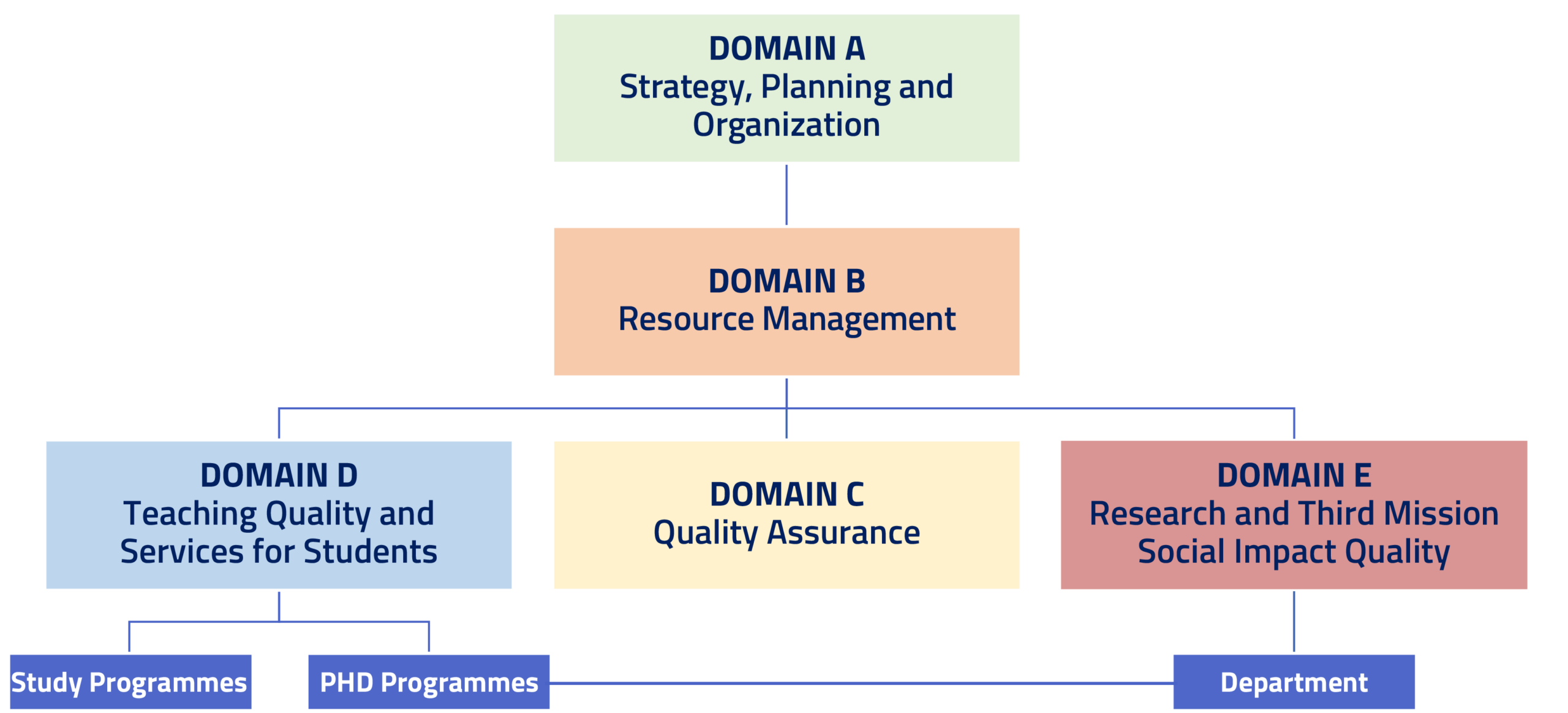
The QA (Quality Assurance) requirements are aligned with the Evaluation Domains and should be interpreted as good practices to be implemented.
An Evaluation Expert Panel (CEV) is responsible for verifying, every five years, during the periodic accreditation process, the fulfilment of the QA requirements, verifying respectively:
- at the central level
- the strategic planning and organization of the Governance and Quality Assurance System (Domain A);
- the resource planning and management processes (Domain B), understood as human resources and as financial, structural, infrastructural, and of information and knowledge management resources;
- the Quality Assurance processes (Domain C);
- the planning and management processes of teaching and services for Students (Domain D);
- and those of research and third mission/social impact (Domain E) developed at University level.
- at the peripheral level
- for Study Programmes: the methods by which the QA processes are implemented by Study Programmes during the design and delivery phases, in resource management, and in the processes of review and continuous improvement (Domain D.CdS);
- for PhD Programmes: the design, planning, and organization of teaching and research activities for the development of PhD candidates, as well as the monitoring and enhancement of such activities (Domain D.PhD);
- for Departments: the definition of strategic guidelines for teaching, research, and third mission/social impact activities; the implementation, monitoring, and review of teaching, research, and third mission/social impact activities; and the definition of criteria for the allocation of resources, personnel, infrastructure, and support services for teaching, research, and third mission/social impact (Domain E.DIP)
Each Domain corresponds to several indicators, of qualitative or quantitative nature, which enable the formulation of the final accreditation judgment, based on the results achieved by the University.
In detail, at University level:
In Domain A – Strategy, Planning and Organization, the aim of this assessment is to evaluate the University’s ability to define, formalise, and implement, through policies, strategies, as well as operational and strategic objectives, a clear, coherent, structured and public vision of the quality of teaching, research, third mission/social impact, and institutional and management activities.
The implementation of such policies, strategies, and operational and strategic objectives must be guaranteed through the implementation of a Governance and Quality Assurance (QA) System equipped with an effective planning and monitoring process for plans and results achieved, as well as clear and transparent procedures for critically reviewing its functioning, involving the various components of the University and taking into account both self-assessment processes and external evaluations received.
In the Strategic Planning and Organization processes, the University must ensure the active involvement of all internal and external stakeholders.
In particular, students should be given an active and participatory role at all levels in the decision-making processes of the governing bodies.
The aspects highlighted above are summarised in the five Points of Attention into which Domain A is structured.
In Domain B – Resource Management, the University’s ability to manage both tangible and intangible resources in support of policies, strategies, and related implementation plans is assessed.
Universities must have an adequate system for the planning, recruitment, qualification, and development of human resources, covering both academic and administrative staff.
They must demonstrate the full financial and economic sustainability of their activities, supported by a system for planning and management financial resources that ensures long-term viability.
Furthermore, universities must demonstrate possession of an effective system for the planning and management of infrastructure, equipment, technologies, data, information, and knowledge used in teaching, research, third mission, and services.
Domain B is structured into five sub-domains, each corresponding to one or more Points of Attention (PdA) referring to the aspects considered.
In Domain C, the Quality Assurance processes are evaluated, with particular attention to the University’s ability to implement a self-assessment system for Study Programmes and Departments, through monitoring and review activities of the processes and outcomes related to teaching, research, and the third mission.
The QA System must include monitoring activities of its effectiveness, involving all relevant bodies and functions at the different levels of responsibility.
To this end, the critical considerations expressed by the NdV are examined.
As part of its institutional functions, the NdV is responsible for evaluating the QA System and the processes related to teaching, research, and the third mission.
All these aspects are considered in Domain C and are summarized the three Points of Attention that define it.
In Domain D, related to the Quality of Teaching and Services for Students, the University must demonstrate a clear overall vision of the planning and structure of its educational provision, also in relation to the national and international context.
The planning and updating activities of Study Programmes must take into account the development needs expressed by the society and by the relevant context, including internationalization objectives and the various modes of teaching delivery (in-person, remote, or blended).
The educational provision of the Study Programmes must be developed consistently with the available teaching, logistical, infrastructural, and research resources.
Study Programmes must focus primarily on students, through the planning and implementation of effective guidance and support activities at entry, during the programme, and upon completion.
These should include clear and transparent admission procedures for the various Study Programmes, as well as systems for career management and tutoring.
The University must also establish a system for managing resources and services to support teaching and students.
Domain D is divided into three Points of Attention and the Quality Assurance Requirements for PhD Programmes (D.PHD) and Study Programmes (D.CdS) are considered relevant.
Within Domain E, the Quality of research and of the third mission/social impact is evaluated, with particular emphasis on the University’s ability to maintain a coherent and comprehensive vision of how Departments (or equivalent entities) define their strategic directions, especially regarding research and third mission/social impact.
In alignment with the University’s strategic guidelines, Departments establish systems for planning, monitoring, and evaluating processes, results achieved, and improvement actions.
The definition and dissemination of criteria for resource allocation at the departmental level are also assessed, ensuring consistency with the Department’s strategic programme and the University’s directives. Additionally, the management system for resources and services supporting research and third mission is evaluated.
Domain E, which is divided into three Points of Attention, includes the Quality Assurance Requirements of the Departments (E.DIP).
Below is the summary table of the Structures’ requirements, listing the Domain, any sub-domain, and Points of Attention with their respective descriptions.
| DOMAIN |
SUB-DOMAIN |
POINT OF ATTENTION |
A
STRATEGY, PLANNING AND ORGANISATION |
|
A.1 Quality of teaching, research, third mission/social impact and quality of institutional and management activities within the University’s policies and strategies |
| A.2 Organisation of the University governance system and Quality Assurance system |
| A.3 Monitoring system of policies, strategies, processes, and results |
| A.4 Review of the University Quality Assurance system and governance system |
| A.5 Role of the students |
B
RESOURCE MANAGEMENT |
B.1
Human resources |
B.1.1 Recruitment, qualification and management of teaching and research staff |
| B.1.2 Recruitment, qualification and management of technical and administrative staff |
| B.1.3 Human resources and services supporting administration, teaching, research and third mission/social impact |
B.2
Financial resources |
B.2.1 Financial resources: planning and management |
B.3
Structures |
B.3.1 Building structures and infrastructures: planning and management |
| B.3.2 Adequacy of building structures and infrastructure for teaching, research and third mission/social impact activities |
B.4
Equipment and Technologies |
B.4.1 Equipment and technology: planning and management |
| B.4.2 Adequacy of equipment and technology |
| B.4.3 Support facilities and services for (full or partial) distance teaching |
B.5
Management of Information and Knowledge Management |
B.5.1 Management of information and knowledge |
C
QUALITY ASSURANCE |
|
C.1 Self-assessment, external assessment and review of Study programmes, PhD programmes and Departments with the support of the University Quality Committee |
| C.2 Monitoring system of the University Quality Assurance system |
| C.3 Evaluation of the Quality Assurance system and processes of teaching, research and third mission/social impact by the University Evaluation Board |
D
QUALITY OF TEACHING AND SERVICES FOR STUDENTS |
|
D.1 Planning of the study offer |
| D.2 Design and update of student-focused Study programmes and PhDs |
| D.3 Admission and students’ career |
E
QUALITY OF RESEARCH AND THIRD MISSION/SOCIAL IMPACT |
|
E.1 Definition of Departments strategies |
| E.2 Evaluation of the results achieved by Departments and PhD programmes and of improvement actions |
| E.3 Definition and publicity of resource distribution criteria |