

Used frying oil can be transformed into polyurethane foams, phase change materials and bio-lubricants capable of replacing fossil-based products in the automotive and construction sectors. This is the result of a series of studies coordinated by the University of Pisa and published in Scientific Reports, Materials Today Sustainability and the Chemical Engineering Journal — high-impact international scientific journals. Professor Maurizia Seggiani of the Department of Civil and Industrial Engineering (DICI) led the work as part of the PNRR MOST National Centre for Sustainable Mobility.
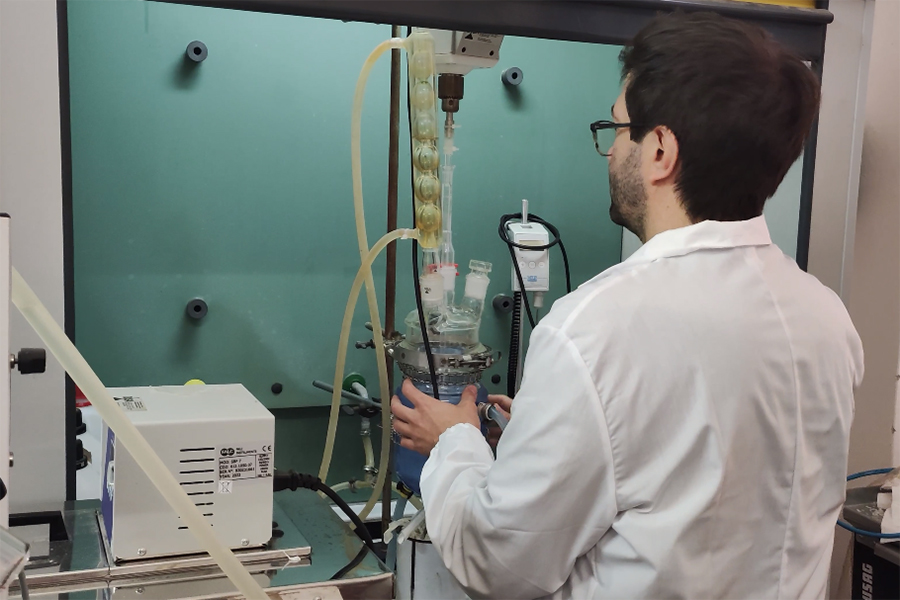
At the heart of this innovation lies the replacement of fossil-based materials with renewable alternatives, such as used cooking oil. The researchers converted the oil into polyols, key components of polyurethane foams, as well as into phase change materials that can absorb, store and release heat to control temperature, and into bio-lubricants for use in industrial hydraulic systems.
In the automotive sector, bio-based polyurethane foams can be used in interior door panels and other components in the passenger compartment to dampen vibrations and stabilise interior temperatures. The phase change materials incorporated into the foam further enhance temperature regulation within the passenger compartment: they absorb heat when the car is exposed to sunlight and release it when the outside temperature drops, thereby improving interior comfort and reducing air conditioning consumption. In construction, these multifunctional foams can be used to improve the thermal and acoustic insulation of walls and building cavities, thereby contributing to energy efficiency and lower energy consumption.
“In an unstable geopolitical context, where access to energy and chemical raw materials is increasingly subject to tensions and strategic dependencies, investing in alternatives to fossil feedstock is not only an industrial and political choice as well as an environmental one,” says Professor Maurizia Seggiani. “Research must anticipate these changes by developing complementary solutions that help reduce the vulnerability of production chains. In this context, the valorisation of local waste, such as waste oil, is one possible strategy for reducing reliance on fossil resources, among others. Transforming waste oil into high value-added materials strengthens technological autonomy, diversifies sources, and builds more resilient production models capable of responding to the global challenges in the coming years.”
This research was carried out by the Department of Civil and Industrial Engineering (DICI), in collaboration with the Department of Energy, Systems, Territory and Construction Engineering, the Interdepartmental Research Centre on Energy for Sustainable Development (CIRESS),
the Polytechnic University of Bari (Department of Civil, Environmental, Land, Building and Chemical Engineering and the Department of Mechanics, Mathematics and Management) and the University of Bologna (Department of Industrial Chemistry “Toso Montanari”). It is part of projects funded by the PNRR MOST National Centre for Sustainable Mobility and was presented in Spoke 11, which focuses on innovative materials and weight reduction.