

Professor Anna Anguissola, Professor of Classical Archaeology at the University of Pisa, is one of the curators, alongside Salvatore Settis and Chiara Ballestrazzi, of Global Antiquity, the new exhibition presented by Fondazione Prada in Milan on 30 July. Designed by Rem Koolhaas and AMO/OMA, the exhibition will be open at Fondazione Prada’s Milan venue from 5 November 2026 to 1 March 2027.
Global Antiquity brings together more than 150 works from international museums and collections to explore the artistic, cultural, commercial and political connections that linked the Mediterranean and Asia between 700 BC and AD 1000. Statues, reliefs, coins, textiles, jewellery and everyday objects trace a network of exchanges spanning continents and seas, revealing the ancient world as a deeply interconnected place.
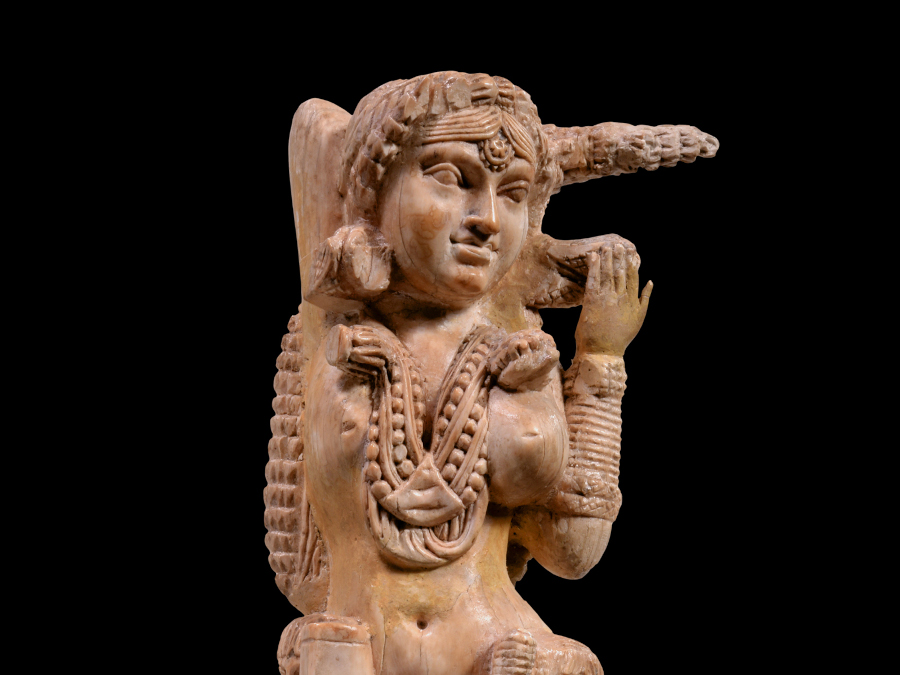
The exhibition explores themes such as globalisation and cultural hybridity, showing how encounters between peoples and traditions gave rise to new artistic and cultural forms. Developed around the concepts of convergence, symmetry and intersection, the exhibition design guides visitors through works from some of the world’s leading museums and cultural institutions, including the Metropolitan Museum of Art in New York, the British Museum in London, the Louvre, the Vatican Museums and the Archaeological Park of Pompeii.
Following Serial Classic (2015) and Recycling Beauty (2022), Global Antiquity marks Anna Anguissola’s third collaboration with Fondazione Prada, continuing a line of research that interprets the ancient world as a lens through which to understand the present.
“The work of an archaeologist consists in reconstructing landscapes, networks of contacts, and the structures and transformations of human societies from the fragments of material culture that have survived the passage of time,” explains Anna Anguissola. “Taking part in such a complex project prompted me to reflect on how to translate the broad historical narratives reconstructed by archaeological research from fragmentary evidence into an accessible account, following the same approach we seek to pass on to our students. At the University of Pisa, the dialogue between archaeologists studying different periods and cultures, from prehistory to the contemporary era, provides the ideal environment for reflecting on the major themes at the heart of the exhibition, such as globalisation and identity.”