

Observing the movement of Pisa’s walls from space: shifts of just a few millimetres per year, imperceptible to the naked eye, yet invaluable for understanding the behaviour of these ancient structures and contributing to their conservation. This unprecedented perspective on Pisa’s cultural heritage comes from a study conducted by the Department of Civil and Industrial Engineering at the University of Pisa, which used satellite radar imagery to monitor the city walls, built almost nine hundred years ago.
The research analysed more than 400 satellite images collected between 2009 and 2023 by the COSMO-SkyMed constellation of the Italian Space Agency. The aim was twofold: to assess whether satellite monitoring could provide a reliable tool for detecting movements in historic structures, and to evaluate the condition of Pisa’s city walls. To this end, the movements measured over time were compared with the characteristics of the ground and the palaeogeography of the area.
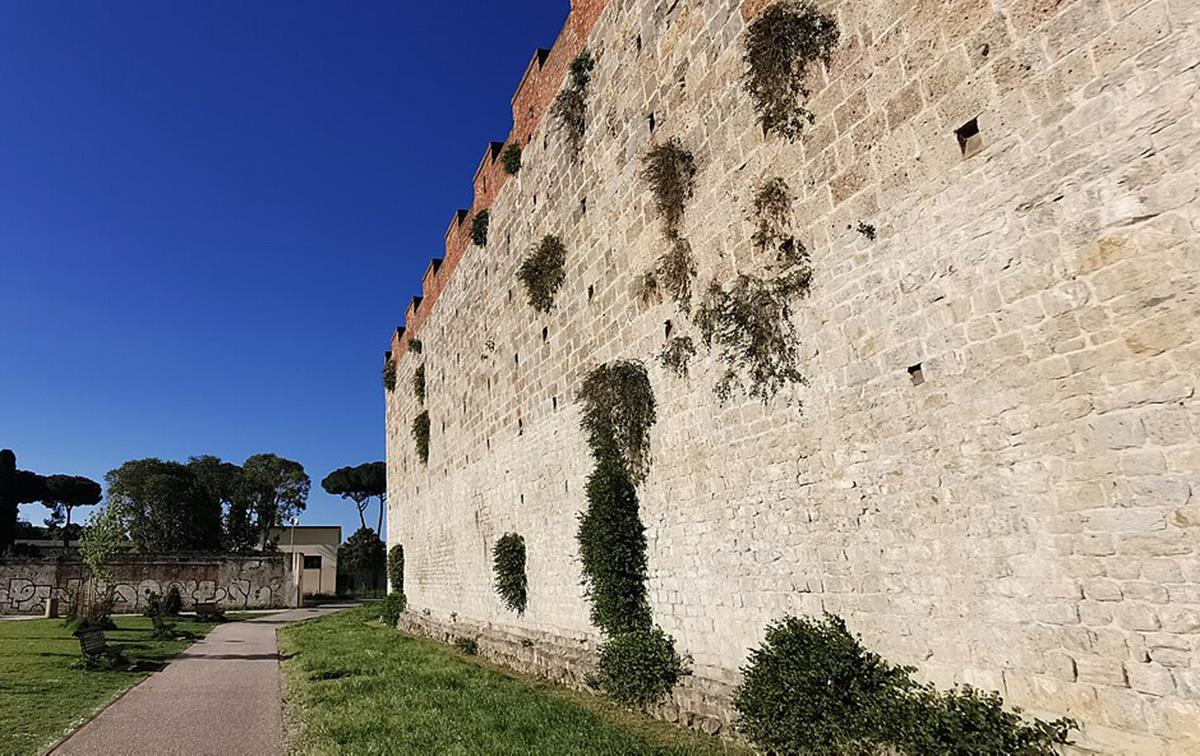
The analyses showed that the walls do not move uniformly but exhibit different behaviours depending on the degree of ground deformability in different parts of the city. Over a period of twelve years, satellite data detected vertical displacements of up to approximately three centimetres and east–west horizontal movements of up to 25 millimetres in some sections of the walls. By contrast, the north-western section surrounding Piazza del Duomo proved to be the most stable part of the entire defensive system. The study of cracks also revealed that many of them are not necessarily attributable to recent movements but appear instead to be linked to the gradual consolidation of the ground caused by the weight of towers and bastions — massive structures built alongside the medieval walls over the centuries, some of which are still standing today.
“The movements of the walls are closely linked both to the deformable nature of Pisa’s ground and to the structure of the wall system itself,” explains Professor Anna De Falco of the Department of Civil and Industrial Engineering at the University of Pisa. “In the case of very extensive structures such as historic walls, bridges or aqueducts, where traditional on-site inspections are often complex and costly, satellite monitoring makes it possible to collect a large amount of data over time and identify the areas requiring more detailed investigation. The technique still needs to be refined and integrated with ground-based measurements, but the results are promising, particularly in view of the launch of new satellite constellations capable of overcoming current limitations.”
The study also highlighted that currently available satellite systems are unable to detect all structural movements, particularly those occurring along the north–south axis, and still have margins of error that make the interpretation of very small deformations challenging.
“At present, satellite monitoring cannot replace traditional techniques, but it can represent a valuable complementary tool for the conservation of cultural heritage,” adds Laura Vignali, PhD candidate at the University of Pisa and first author of the study. “The possibility of observing extensive structures such as city walls over time, detecting even minimal movements on a large scale and in a non-invasive way, opens up new opportunities for identifying the most vulnerable areas and planning targeted inspections and interventions.”
The study on Pisa’s walls, entitled “Satellite Observations for Linear Heritage Assets Conservation: The Case of the Ancient City Walls of Pisa, Italy”, was presented in preliminary form at an international conference dedicated to the monitoring of historical heritage. The initiative forms part of the Extraordinary Plan for the Monitoring and Conservation of Immovable Cultural Heritage, launched by the Italian Ministry of Culture through an implementation agreement involving the Department of Civil and Industrial Engineering of the University of Pisa, the Opera della Primaziale Pisana, the Ministry’s General Director for Safety, and the Office of the Special Superintendent for the Areas Affected by the Earthquake of 24 August 2016.