


A model of the human intestine capable of “moving” like the real organ, reproducing in the laboratory both peristalsis and the mechanical stresses experienced by intestinal cells every day. This is the result of a study published in the journal Results in Engineering by the biofabrication research group led by Professor Giovanni Vozzi of the Department of Information Engineering and the “E. Piaggio” Research Centre at the University of Pisa, in collaboration with Professor Yu Shrike Zhang of Brigham and Women’s Hospital and Harvard Medical School in Boston.
The new device, technically a bioreactor, recreates an environment much closer to that of the human intestine than traditional models, while maintaining cell viability for at least 28 days. In addition to supporting cell culture, the system reproduces peristalsis, the rhythmic movement that enables the intestine to function properly. In response to this mechanical stimulation, the cells spontaneously organise themselves into three-dimensional structures resembling intestinal villi.
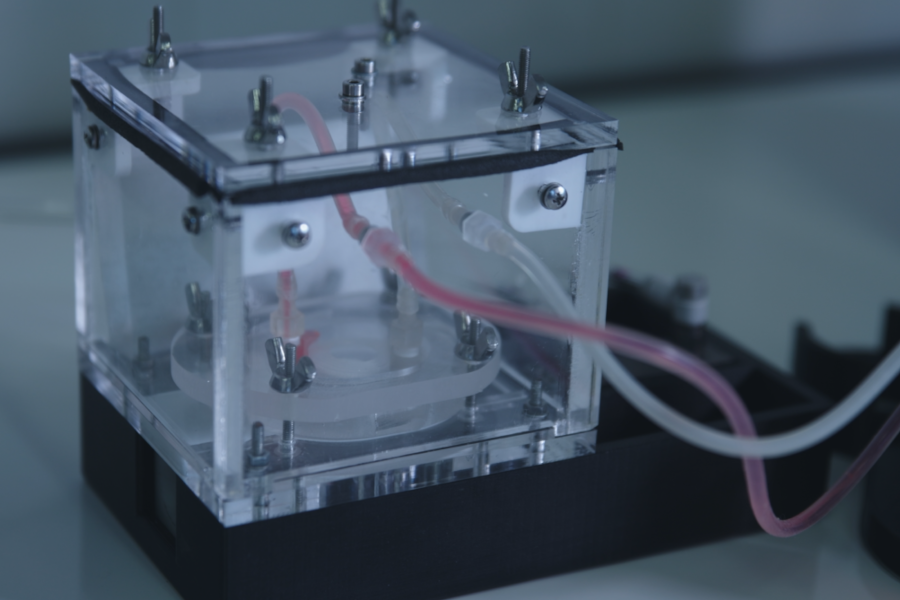
“Our aim was to overcome the limitations of currently available models, which reproduce the intestinal environment only partially,” explains Giovanni Vozzi. “We have demonstrated that the mechanical movement of the intestine is not simply a physiological detail, but an essential factor in guiding the development of more realistic tissue. Having models that closely mimic the behaviour of the human intestine means being able to study diseases more accurately, assess the effectiveness of new drugs and progressively reduce the need for animal testing.”
The bioreactor was developed as part of a PhD project and the MICRO-B project, funded through the University of Pisa’s 2022 Call for Technology Demonstrators, and has been patented in collaboration with the research group led by Professor Emilia Ghelardi of the University’s Department of Translational Research and New Technologies in Medicine and Surgery. Compared with currently available devices, the system has low production costs, a modular architecture and the ability to reproduce, in a physiologically realistic manner, the mechanical stresses experienced by the intestinal wall.
The potential applications extend well beyond the study of the intestinal barrier. Thanks to its versatility, the bioreactor could be connected to other biological models, beginning with the gut microbiota model already developed by the same researchers. The next step will therefore be to integrate the new intestinal model with other tissues to recreate the microbiota–gut–heart–brain axis in the laboratory and investigate the origins and progression of cardiovascular and neurodegenerative diseases.
This line of research is already the focus of two PhD projects involving, in addition to Vozzi and Ghelardi, Professor Vittoria Raffa and Professor Arianna Tavanti, both from the University of Pisa, and Dr Federico Vozzi of the Institute of Clinical Physiology of the CNR (Consiglio Nazionale delle Ricerche).