

Nearly twenty years later, researchers from the University of Pisa returned to the exact same points along the coastline between Pisa and Livorno where surveys had been carried out between 2005 and 2007. The result is stark: in many cases, where there were once dunes, there is now sea. The findings emerge from a study published in the international journal Regional Studies in Marine Science, which re-examined 24 plots — defined as the areas within which vegetation surveys were conducted — in the San Rossore Estate and 28 in Calambrone.
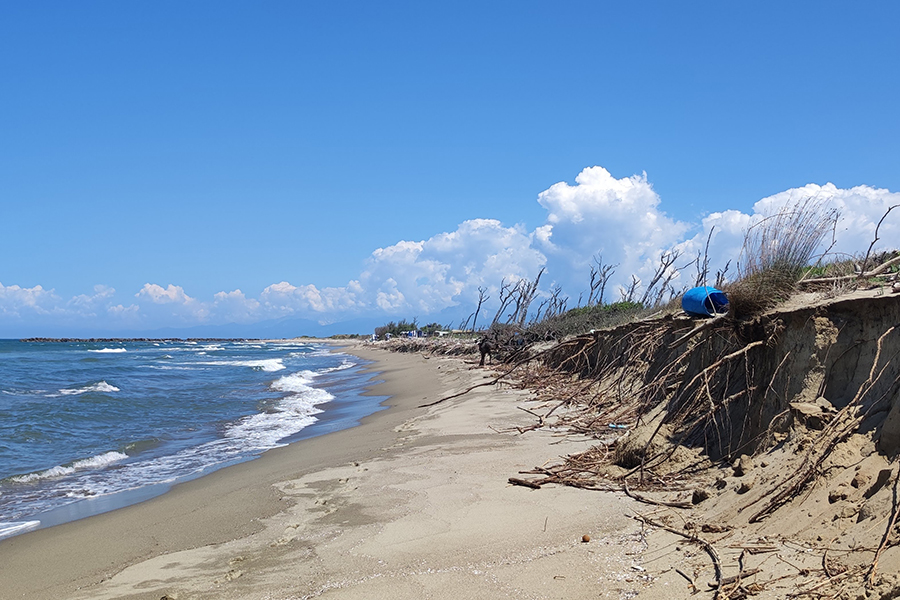
Along the 12 kilometres of coastline at San Rossore, between the mouths of the Serchio and Arno rivers, only 13 of the original 24 plots were relocated: many no longer exist because they are now literally underwater, as a result of coastal erosion. Along the 3.5 kilometres of coastline at Calambrone, the situation is equally critical, although for different reasons. All six plots located closest to the shoreline twenty years ago have disappeared, replaced by beach establishments.
“When we returned to the same coordinates with the GPS data from twenty years ago,” explains Professor Daniela Ciccarelli of the Department of Biology at the University of Pisa, “in some cases there was no longer a dune, no longer even a beach — there was the sea. This means we have physically lost sections of coastline and habitats protected at European level.”
According to the European Union’s Habitats Directive, 89% of dune habitats in Italy are considered at risk. The new local data confirm a broader trend of degradation which, in the Pisa area, has a dual dimension.
At San Rossore, erosion is the dominant factor. Between 1938 and 2005, the shoreline retreated by up to 400 metres in the most affected areas, equivalent to 6.8 metres per year. This is compounded by vegetation changes, including the expansion of invasive species such as Ailanthus altissima, which promote the replacement of open sandy habitats with denser formations less typical of dune ecosystems.
At Calambrone, by contrast, the main pressure is anthropogenic. In 2024, more than 2.1 million tourist presences were recorded along the Pisan coastline. Mechanical beach cleaning and constant trampling primarily affect annual plant species closest to the sea, such as Cakile maritima, which survive the winter as seeds buried in the sand.
“Plants that grow closest to the shoreline are often annuals,” Ciccarelli explains, “and they remain beneath the sand as seeds. If mechanical cleaning is carried out at the start of the bathing season, seeds and fruits are removed along with the waste. As a result, the habitat is no longer able to regenerate properly.”
Even an apparently positive finding — such as the increase in the number of species observed at Calambrone — conceals a signal of ecological impoverishment. The study recorded a decline in species such as Calamagrostis arenaria and Sporobolus pumilus, whose root systems stabilise and consolidate dunes. “It is not a true increase in biodiversity,” the professor clarifies, “but rather a loss of the ecosystem’s functional identity.”
The study forms part of the national ReSurveyDunes project, launched in 2023 to assess changes in dune vegetation across Italy. The added value of the Pisa research lies precisely in the direct comparison between past and present conditions at the same sites over a twenty-year interval.
The recommendations that emerge for managing the situation are concrete and low-cost: reducing mechanical beach cleaning, installing wooden walkways to channel visitor flows and prevent widespread trampling, limiting the expansion of beach facilities onto dunes, and strengthening control measures against invasive species.
“This is not only about saying what should not be done,” Ciccarelli concludes, “but about explaining why dunes have fundamental ecological value: they protect the coastline, host unique species and represent a natural heritage that, once lost, is extremely difficult to restore.”