

In 2025, the world’s glaciers continued to lose mass at an extremely rapid pace. This is the finding of a new study coordinated by the World Glacier Monitoring Service (WGMS), to which the University of Pisa also contributed through Professor Carlo Baroni of the Department of Earth Sciences, in his role as the Italian correspondent for the WGMS.
According to the study, published in Climate Chronicles of Nature Reviews Earth & Environment and in the State of the Climate in Europe 2025 Report (Copernicus Climate Change Service and World Meteorological Organisation), during the 2025 hydrological year — excluding the ice sheets of Greenland and Antarctica — global glaciers recorded a net mass loss of 408 gigatonnes (±132 gigatonnes), equivalent to a sea-level rise of 1.1 millimetres (±0.4 millimetres).
This figure confirms a well-established trend: glacier mass loss has accelerated significantly in recent decades. It has increased from around 100 gigatonnes per year in the period 1976–1995, to approximately 230 gigatonnes per year in 1996–2015, reaching an average of about 390 gigatonnes per year in the last decade (2016–2025) — nearly four times higher than in the 1970s and 1980s.
Overall, since 1975, glaciers have lost approximately 9,583 gigatonnes of mass (±1,211 gigatonnes), contributing to a sea-level rise of around 26.4 millimetres (±3.3 millimetres).
“To give an idea of the scale of the process under way,” explained Michael Zemp, Director of the WGMS, “the annual glacier mass loss in 2025 could have filled five Olympic swimming pools every second for the entire year.”
The study is based on observations collected by a wide international network of researchers, universities and research institutions, including the Italian Glaciological Committee, coordinated by the WGMS.
The contribution of the University of Pisa and the state of Italian glaciers
Within this global framework, the contribution of the University of Pisa focused in particular on the monitoring and analysis of Italian glaciers. The data reveal a critical situation across the entire Alpine arc.
“In the 2025 hydrological year,” explains Professor Carlo Baroni of the University of Pisa, “all monitored Italian glaciers recorded negative mass balances, confirming a well-established trend that is of serious concern for the future of our water resources.”
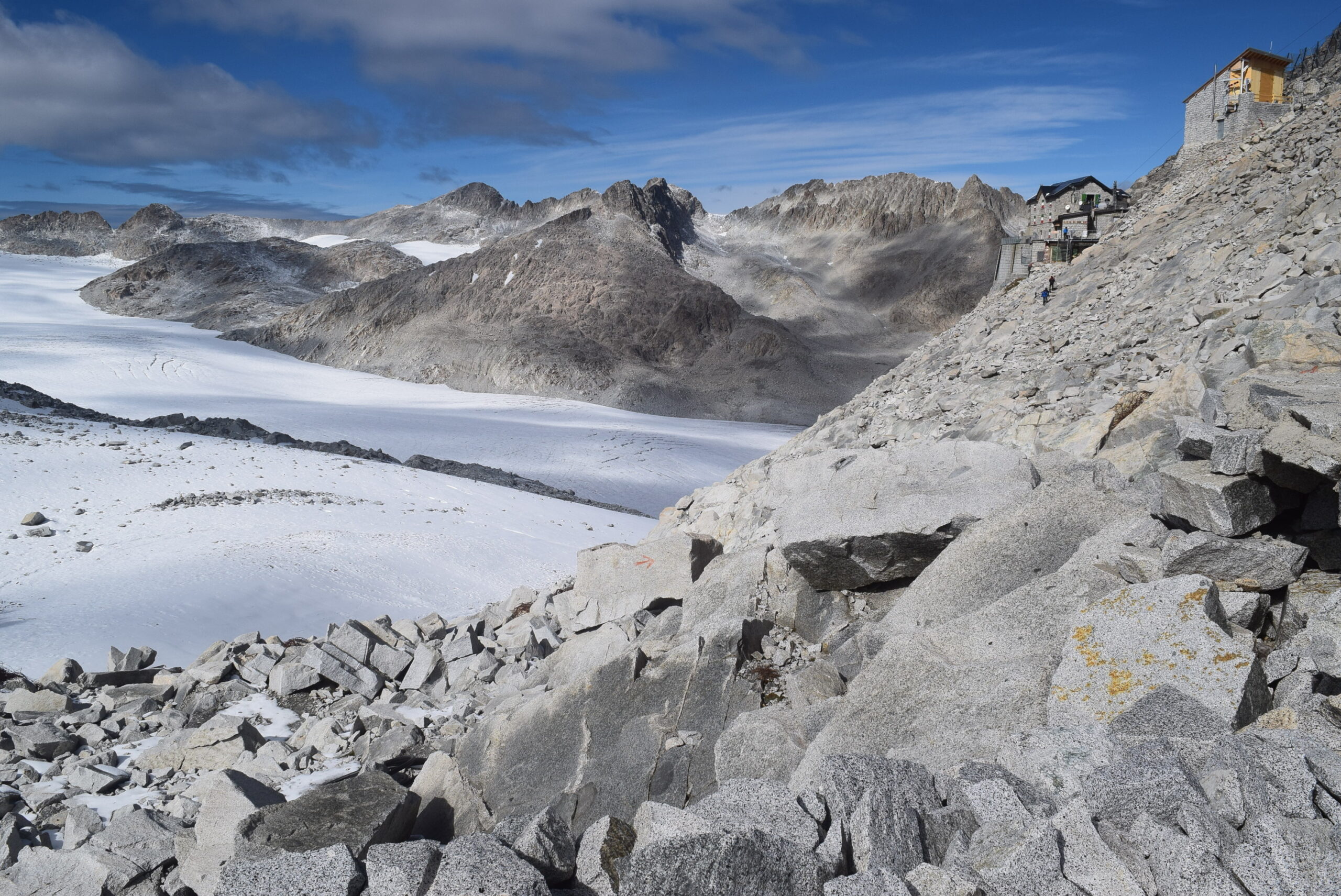
More specifically, all 16 Italian glaciers monitored, together with the Calderone glacieret in the Gran Sasso massif, showed losses, with a median loss of –1038 mm water equivalent. The most critical situations were recorded at the Vedretta Pendente, Malavalle Glacier and Careser Glacier, while more limited losses were observed at the La Mare Glacier, Western Montasio Glacier and Calderone.
Abundant winter snowfall helped to partially mitigate losses in the Piedmont–Aosta Valley sector, particularly at the Ciardoney Glacier. By contrast, Lombardy and the Triveneto region recorded more limited snow accumulation, with especially critical conditions in Lombardy and the Rhaetian Alps (Careser and Malavalle).
Summer melt remains the decisive factor, particularly for glaciers with limited winter accumulation. This continues to drive the negative mass balances observed in recent years and highlights the growing urgency of sustained monitoring.
Data on Italian glaciers are currently being published in volume 49 (2026) of the journal Geografia Fisica e Dinamica Quaternaria.