

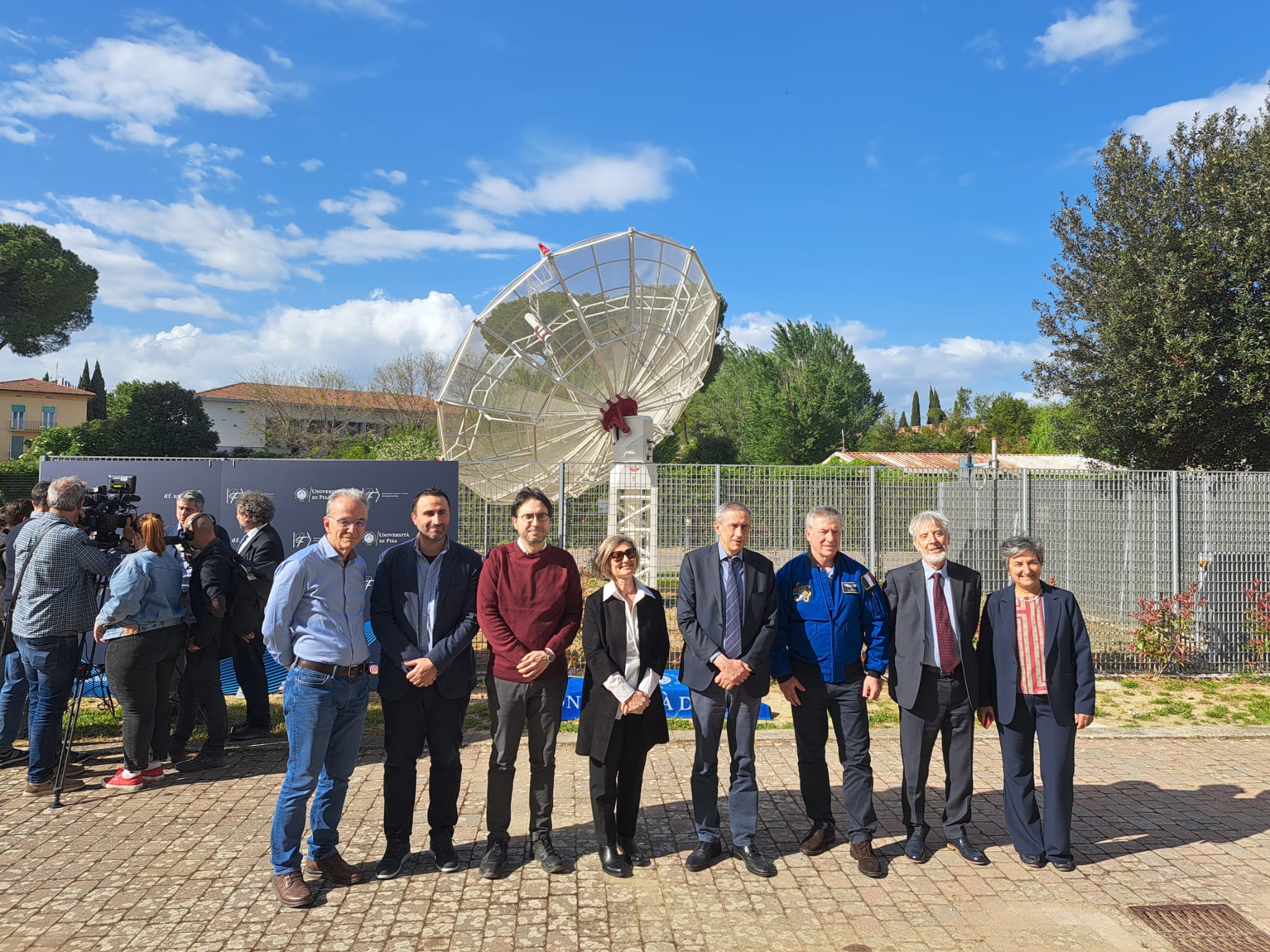
Listening to space, observing hydrogen clouds in the Milky Way and using them to build a three-dimensional map of our Galaxy will now also be possible thanks to PULSAR, the largest educational radio telescope in Italy, inaugurated on 15 April at the Department of Physics “Enrico Fermi” of the University of Pisa. The name and logo are the result of a design competition involving students from the Department.
Radio astronomy is a branch of modern astrophysics that does not observe the sky through visible light, but rather “listens” to it, capturing and analysing radio waves coming from space. This approach makes it possible to study the Universe in a different and complementary way compared with optical telescopes, providing an unprecedented map of celestial bodies and physical phenomena invisible to the human eye.
The new instrument — a radio telescope with a 5-metre-diameter dish — is designed to detect radio signals at a frequency of 1420 MHz, corresponding to the so-called 21 cm emission line of neutral hydrogen: a key signature for studying the distribution of this element in the Universe and tracing the structure of our Galaxy. It is equipped with an automatic pointing and tracking system and connected via fibre optics to the control room located in the Department’s teaching laboratories.
The inauguration took place as part of an event open to the public, featuring live observations and a discussion on the frontiers of space exploration with astronaut Roberto Vittori and science journalist Piero Bianucci. Also present were Rector Riccardo Zucchi and Chiara Maria Angela Roda, Director of the Department of Physics.
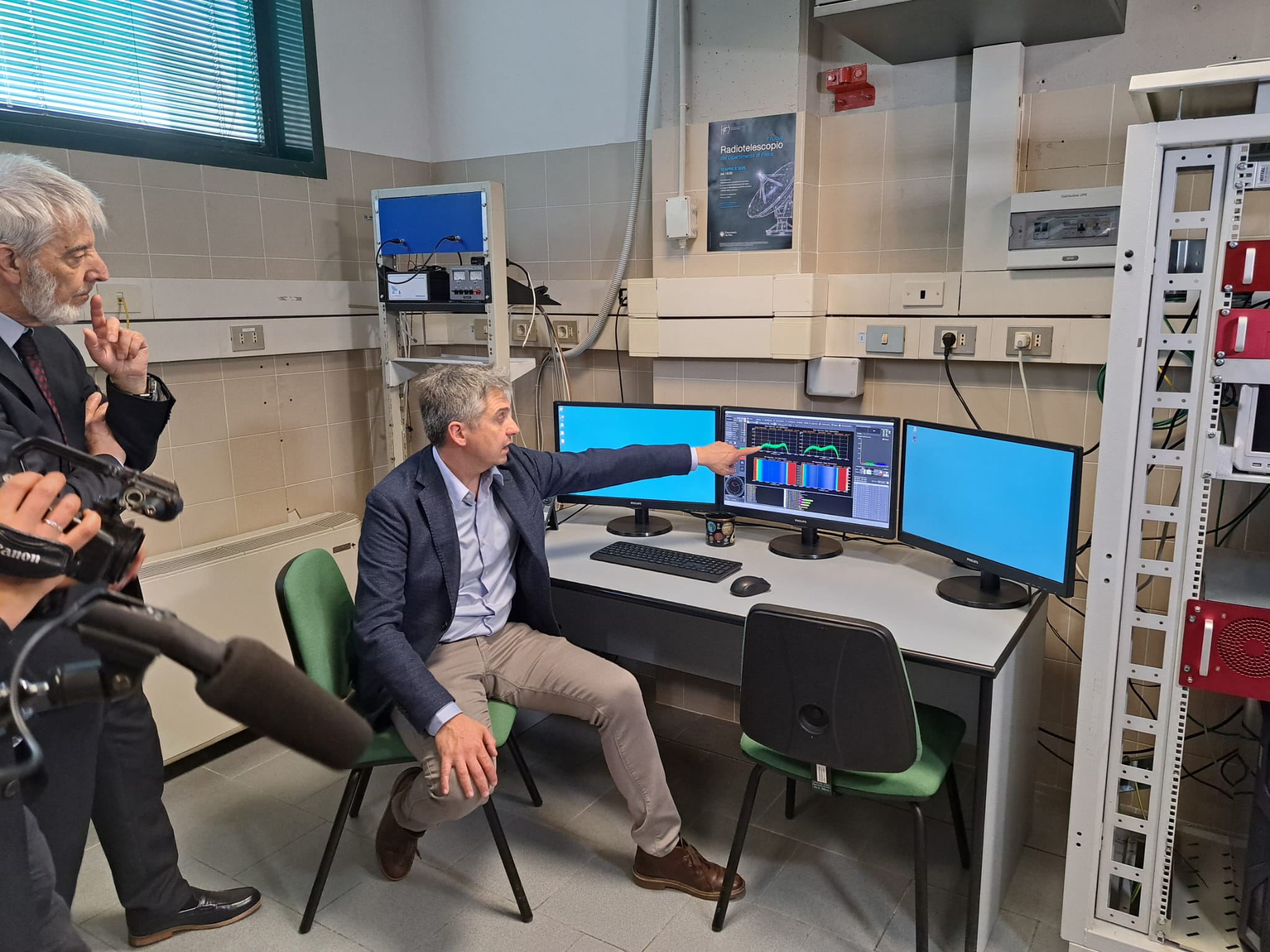
“The new radio telescope is a professional instrument that enables astrophysical observations of great educational and scientific value,” explained Professor Massimiliano Razzano of the University of Pisa, the scientific coordinator of the new instrument. “Unlike traditional telescopes, it can operate during the day and even under cloudy skies, thus maximising its potential use. In addition to the 21-centimetre line, its high sensitivity allows the detection of various types of radio sources, from the Sun to other classes such as supernova remnants and radio galaxies.”
“This investment was made possible through funding from the Ministry of University and Research within the framework of the ‘Department of Excellence’ programme,” said Professor Dario Pisignano of the Department of Physics. “It is a recognition of the quality and innovative nature of the Department’s research, which today translates into cutting-edge instrumentation and new opportunities for students and researchers.”
“Laboratory experience is a central element in the training of physicists,” concluded Chiara Maria Angela Roda. “Having access to advanced instruments such as this radio telescope allows students to engage directly with research during their studies. The installation of this instrument is a remarkable achievement made possible by the collective effort of the Department staff and the University administration.”