

Some stories seem to begin suddenly, marked by a symbolic date that makes them memorable. For the Internet in Italy, that date is 30 April 1986, when the first connection to the global network was established from the National University Centre for Electronic Computing (CNUCE) in Pisa. Today, a plaque in Via Santa Maria, just a few hundred metres from Piazza dei Miracoli, commemorates that event.
Yet no innovation truly begins in a single day. The story of forty years of the Internet in Italy, rooted in Pisa, began long before 1986. For this reason, on 13 May, the University of Pisa organised the event “Internet-40. From the first connection to digital citizens. Innovation, society and new challenges in artificial intelligence and security”, to revisit this history and reflect on ongoing transformations.
The beginnings: from Enrico Fermi to IBM
Why Pisa? The origins date back to 1954, to a funding allocation of 150 million lire and a letter from Enrico Fermi to the Rector of the University of Pisa, Luigi Avanzi. Fermi suggested that these resources — made available by the provinces and municipalities of Pisa, Lucca and Livorno — should be used to build an electronic computing machine.
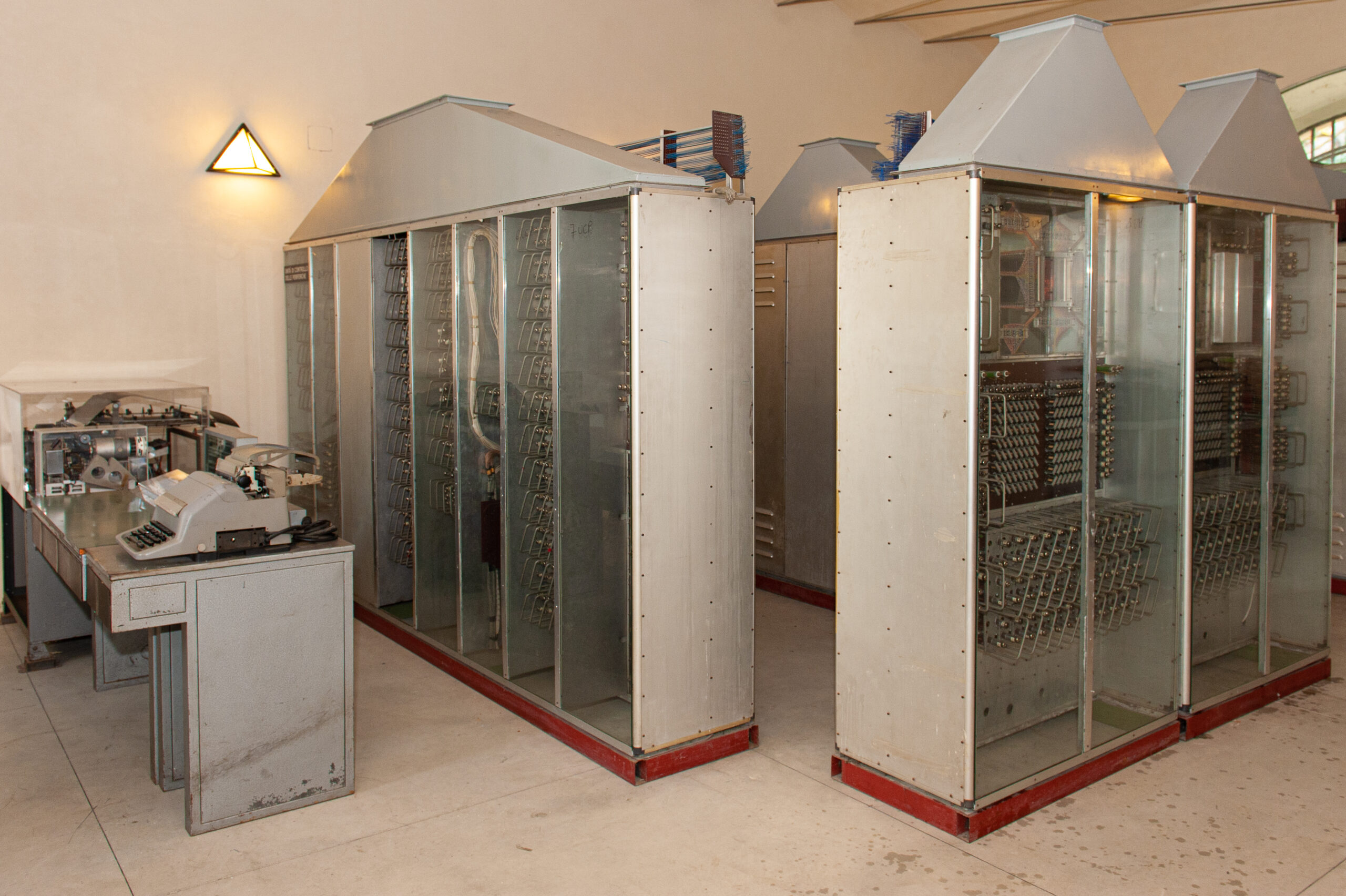
This idea led to the creation of the Calcolatrice Elettronica Pisana (CEP), inaugurated in 1961 by the President of the Republic Giovanni Gronchi — one of the first large computers in Europe, now preserved at the University’s Museum of Computing Instruments. However, the most important outcome was not just the machine itself. Around the CEP, a research community developed that led, in 1965, to the establishment of the National University Centre for Electronic Computing (CNUCE), inaugurated in the presence of President Giuseppe Saragat. On that occasion, Rector Alessandro Faedo observed:
“When the CEP was completed, we realised that the greatest result was not the machine itself, but the creation of a group of scholars who wanted to continue working scientifically in this field.”
CNUCE, also supported by the donation of an IBM 7090, became the driving force behind computing development in Pisa. In 1969, Italy’s first degree programme in Information Engineering was established, and in 1974 the Centre became part of the National Research Council (CNR).
Watch the video featuring interviews with the key figures in the history of the Internet in Pisa.
1986: the first ping
When the Internet arrived in Italy in 1986, it was an important project, but its full significance was not yet widely understood. This is recalled by Luciano Lenzini, Professor at the Department of Information Engineering and one of the key figures of that period:
“On 30 April, a ping was sent to a computer in Pennsylvania. After a few milliseconds, the reply came back: the connection had been established. Italy was online.”
This achievement was made possible by Lenzini’s contacts with Robert Kahn, one of the founding figures of the Internet, who in 2006 received an honorary degree in Pisa together with Vinton Cerf.
“For us,” Lenzini continues, “it was a major research project that anyone working on networks aspired to join. The real turning point came in the early 1990s, with the invention of the web.”
The web: Italy’s first webpage created in Pisa
The arrival of the World Wide Web marked a new phase, once again with Pisa at the forefront.
“I was a physics student and met Tim Berners-Lee at CERN,” recalls Maurizio Davini, Professor at the University of Pisa and coordinator of the Green Data Center. “I was struck by the computer he was using, a NeXT machine, which was extremely rare at the time. Out of curiosity, I approached him.”
That encounter led to something more:
“He showed me a project he was working on — the World Wide Web — and gave me the code to test it in Pisa on Unix systems.”
Thus, www.unipi.it became Italy’s first web page. Until then, the network had been used mainly for scientific purposes, such as file sharing and email.
The future: the quantum internet
Pisa also preserves the computer from which that first ping was sent: a 1984 Mac, now on display at the Museum of Computing Instruments.
“Before the Internet, the main use of personal computers at home was video games,” observes the museum’s director, Giuseppe Lettieri.
Today, after transforming communication, the economy and society, the Internet is once again turning to physics for its future development: the quantum internet.
“The paradigm is radically different from that of the classical Internet,” explains Lenzini. “We are talking about entanglement and teleportation. These are concepts that, from a research perspective, still have something of science fiction about them.”
According to the scientific community, the quantum internet will not replace the current one, but will complement it, enabling applications that are currently unimaginable, such as the intrinsically secure sharing of encrypted information.
“A European infrastructure developed by the Quantum Internet Alliance already exists, with some basic functionalities, although further developments are needed, especially in quantum memories,” notes Marilù Chiofalo, Professor at the University of Pisa and a signatory of the international manifesto Women for Quantum. “Investment is significant, but attention must also be paid to the geopolitical context.”
These technologies may also have military applications. For this reason, Chiofalo concludes: “It is essential that their development is accompanied by awareness, transparency and international cooperation.”