

It rains less in Italy, but when it does rain, the downpours are more intense. This is the picture outlined by a new study from the University of Pisa, authored by Marco Luppichini and Monica Bini of the Department of Geosciences and published in the international journal Atmospheric Research. For the first time, researchers analysed more than 200 years of rainfall data drawn from historical archives and modern instrumental networks, reconstructing the evolution of precipitation across six major Italian climate zones.
The findings show that the largest reductions in rainfall occur mainly in the Po Valley and the Upper Adriatic, with three major historical minima around 1820, 1920 and 1980. The most extreme events, i.e. the peaks in rainfall intensity, emerge in the same areas, with maximum values around 1870, 1930 and 2003. A significant increase in precipitation intensity is also evident in the Ligurian–Tyrrhenian regions, including Tuscany and Lazio, throughout the period from the nineteenth century to the present day.
According to the study, the main driver of this change is global warming, which is altering the circulation of air masses over Europe and the Mediterranean. Atlantic disturbances reach Italy less frequently because large-scale atmospheric configurations — such as the Azores High — have strengthened and now block rainfall. At the same time, the Genoa Low cyclonic system, which normally brings much of the peninsula’s rainfall, has weakened. Adding to this is an increasingly warm Mediterranean Sea, which generates more atmospheric moisture and energy: this does not increase total rainfall but makes individual precipitation events more intense and violent.
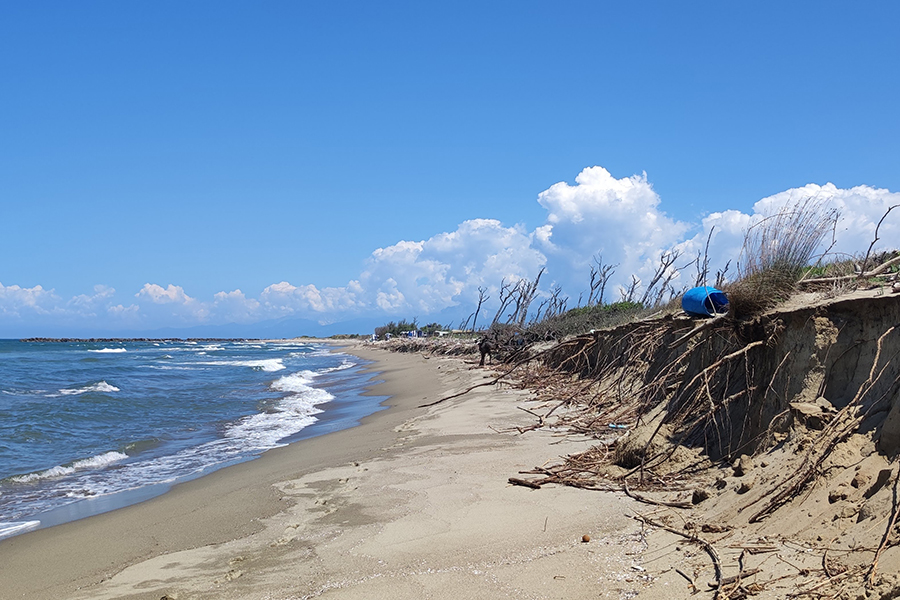
“This combination — less rain but more intense rainfall — outlines complex future scenarios,” explains Marco Luppichini. “On the one hand, the decline in average precipitation reduces groundwater recharge, exacerbates summer droughts and places water systems under strain, especially in densely populated and agricultural areas such as the Po Valley, the Tyrrhenian regions and the Apennine hinterland. On the other hand, the increase in the intensity of rainfall events amplifies the risk of landslides, flash floods and overloads of urban infrastructure, with impacts already observable in many areas of north-western Italy and the central Tyrrhenian coast.”
Looking in detail at the past two centuries, trends across the six major Italian climate zones are broadly similar, though with varying intensity. In the Alps, overall rainfall totals have remained largely stable, but intense events have become more frequent. The Po Valley and Upper Adriatic stand out as the areas where change is most pronounced, with sharp declines in total precipitation and a continuous rise in intensity. The central-southern Adriatic has seen a reduction in rainfall alongside strong variability in intensity, which has increased again over the past twenty years. The Ligurian and Tyrrhenian regions show a slight but steady decrease in total rainfall and a regular increase in intensity. In the central-southern Apennines, rainfall has declined markedly since the twentieth century, while intensity has increased irregularly. Southern Italy and Sicily also confirm the national trend: after an initial increase, total rainfall stabilised and declined in the 1980s, while intensity has risen particularly in recent decades.
“Understanding these dynamics is essential for designing effective adaptation measures,” concludes Monica Bini. “As a result of global warming, the trends identified in historical series could intensify in the coming decades, making future scenarios even more unstable, with less rainfall and more extreme events.”