


Cooling indoor spaces during heatwaves while using little energy: one solution could come from simple systems such as evaporative coolers. Even when the room temperature drops by only a few degrees, the cooling effect experienced by the body can be much greater, thanks to the combination of cooler air and increased air movement. The effectiveness of these alternative ways of coping with extreme heat was analysed in a study published in the scientific journal Building and Environmentt, involving Roberto Rugani and Giacomo Salvadori of the Department of Energy, Systems, Territory and Construction Engineering at the University of Pisa.
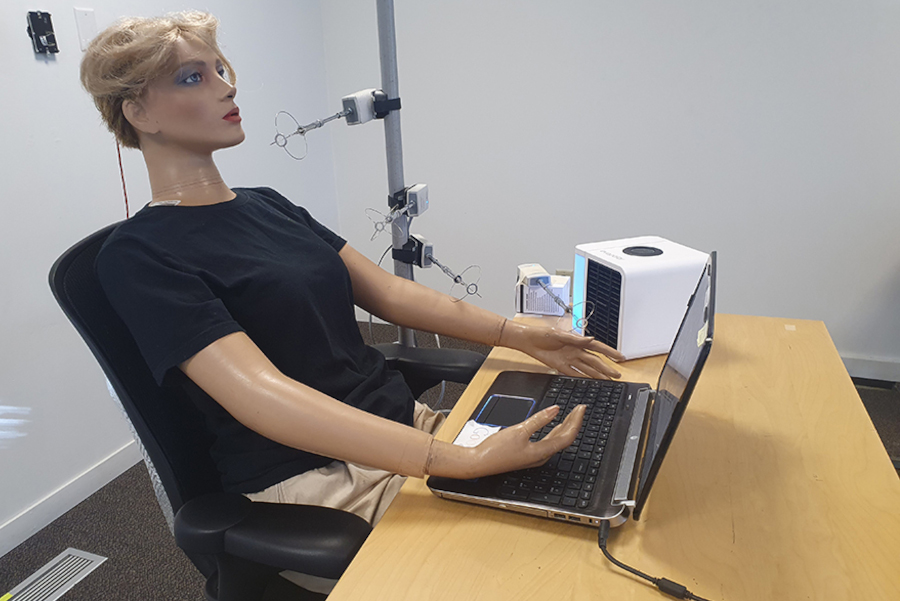
Rugani conducted the research as part of his PhD, under the supervision of Giacomo Salvadori, and, thanks to funding from the University of Pisa for international mobility, carried out the experimental work at the University of California, Berkeley. The tests were conducted in a climate chamber, at an initial temperature of 32°C and under dry conditions typical of many heatwaves. The researchers used two devices, one for the room and one for personal use at a desk. To assess the benefits for the body, the team used a special thermal manikin capable of reproducing heat exchange between a person and the surrounding environment.
“In our experiments, the room temperature fell by around 3°C, while the average cooling effect on the body reached around 6°C when the room cooler was combined with the personal cooler. The perceived relief can therefore be considerably greater than the drop shown on the thermometer,” explains Rugani.
All this comes with very low energy consumption: a personal cooler uses around 10 watts, while the room unit uses 220 watts. By comparison, a domestic air conditioner can use between 1,000 and 2,000 watts. According to some estimates, using evaporative coolers could therefore reduce daily electricity consumption by between 62% and 74%.
“The advantage is particularly significant during heatwaves, when the simultaneous use of air conditioners can cause peaks in electricity demand and put the grid under pressure,” concludes Rugani. “Thanks to their low power consumption, these devices can also run on batteries and continue to provide relief during power outages. More generally, they could offer an affordable alternative for people who do not have access to air conditioning.”