

The University of Pisa is also contributing to NASA’s Artemis II mission, launched on 2 April and which will see astronauts return to the Moon for the first time since 1972. The Orion spacecraft carries six Timepix chips on board. These are advanced sensors for detecting particles and radiation, developed at CERN as part of the international Medipix2 collaboration, in which the University of Pisa and the National Institute for Nuclear Physics (INFN) are both involved.
The devices are designed to monitor the characteristics and levels of radiation inside the spacecraft in real time during the ten-day mission. This is a crucial aspect, since astronauts will be exposed to significantly higher radiation levels once they are beyond the protection of the Earth’s geomagnetic field than they would experience in low Earth orbit.
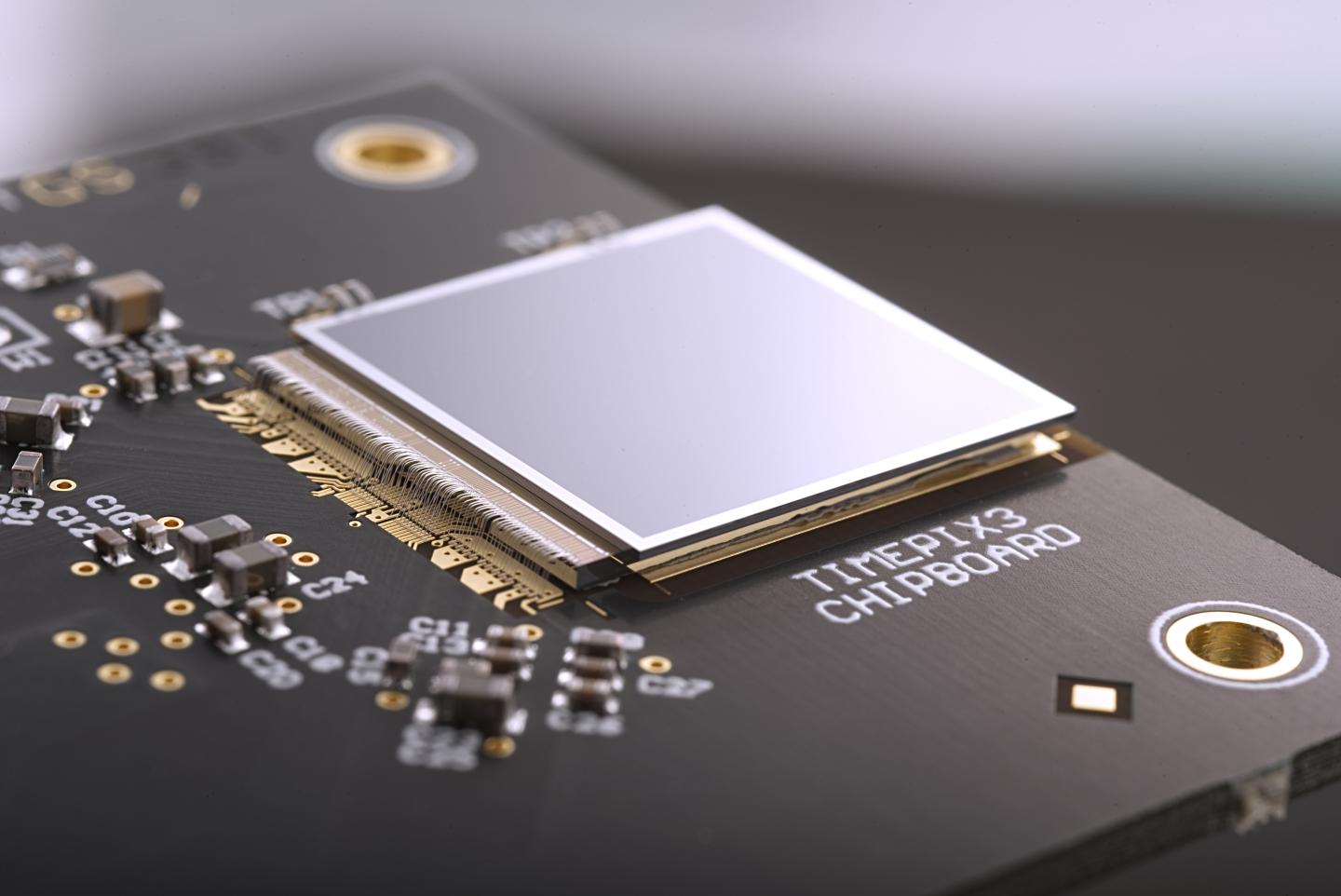
The Timepix chips are part of the HERA (Hybrid Electronic Radiation Assessor) system, developed by NASA. They allow the composition, intensity and energy of incoming particles to be measured, contributing to the assessment of radiation exposure for both the crew and onboard electronic systems. This technology is derived from hybrid pixel detectors used in experiments at the Large Hadron Collider and can identify different types of radiation by analysing the tracks left by particles in the sensors.
“Devices similar to those used in the lunar mission are also employed in the teaching laboratories of the Master’s Degree in Medical Physics,” explains Professor Maria Giuseppina Bisogni of the University of Pisa. “We have now reached the fourth generation of these detection systems, which are used in both fundamental research and in applications, including in the medical field.”
“The Medical Physics group at the University of Pisa,” adds Professor Valeria Rosso, “has been working on these detectors since they were first produced in the late 1990s, contributing to the development of imaging systems based on them. These systems offer much greater imaging precision and could lead to significant improvements, for example in X-ray medical diagnostics, in the future.”
Alongside Maria Giuseppina Bisogni and Valeria Rosso, colleagues from the Department of Physics at the University of Pisa — Pasquale Delogu, Maria Evelina Fantacci and Piernicola Oliva — are also involved in research in this field.