

The most massive star clusters emerge more rapidly from the clouds of gas and dust in which they are born. This is the finding of a study published in Nature Astronomy and conducted by an international research team that includes Michele Cignoni of the Department of Physics at the University of Pisa, who is also affiliated with the Pisa section of the INFN.
“This work represents one of the most extensive surveys of the earliest stages in the life of star clusters and shows, on a statistical basis, that their mass determines the time required to emerge from their natal cloud,” explains Michele Cignoni. The research combined observations from the James Webb Space Telescope (JWST) with images from the Hubble Space Telescope (HST), analysing approximately 8,900 young star clusters in the galaxies M51, M83, NGC 628 and NGC 4449.
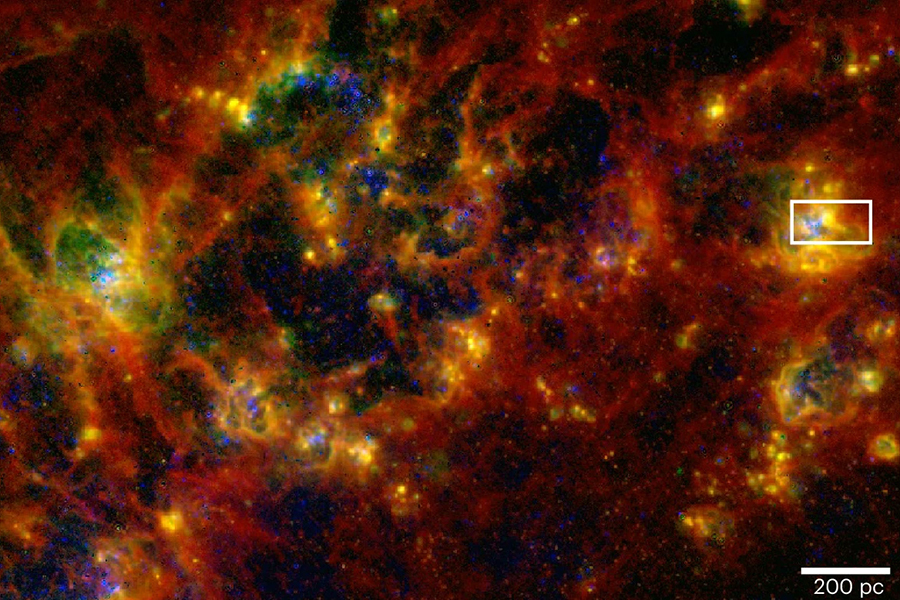
Thanks to the infrared sensitivity of JWST, the team reconstructed an evolutionary sequence ranging from the youngest clusters, still associated with ionised gas and dust, to clusters visible at optical wavelengths. According to the study, the most massive clusters disperse the surrounding material in around five million years, whereas less massive clusters may take seven to eight million years.
The research also has important implications for understanding how galaxies evolve and how planets form. The findings help clarify how stars are born and how the youngest and most massive ones influence their surroundings through their intense radiation. The consequences also extend to planet formation: if larger star clusters emerge earlier, the discs of gas and dust surrounding young stars are exposed more quickly to ultraviolet radiation, reducing the time available for planetary growth.
The study published in Nature Astronomy was led by Alex Pedrini and Angela Adamo of Stockholm University and is based on data from the FEAST programme (Feedback in Emerging extrAgalactic Star clusTers), coordinated by Angela Adamo.