

On Monday 22 December, the University of Pisa officially welcomed five students who arrived in recent weeks from Palestine during a ceremony held at the Palazzo della Sapienza. The event reaffirmed the University’s commitment to implementing the principles of peace, social responsibility and international solidarity, as enshrined in its Statute.
The ceremony opened with greetings from Rector Riccardo Zucchi and was attended by Enza Pellecchia (Vice-Rector for Community Cohesion and the Right to Education), Giovanni Federico Gronchi (Vice-Rector for Cooperation and International Relations), Antonio Soluri (Deputy Head of the Pisa Police Headquarters), and Frida Scarpa (City Councillor). Representatives of the Italian Red Cross were also present, together with organisers from the Fiori dai Cannoni initiative and the Associazione Sante Malatesta, which contributed to the development of the reception pathways.
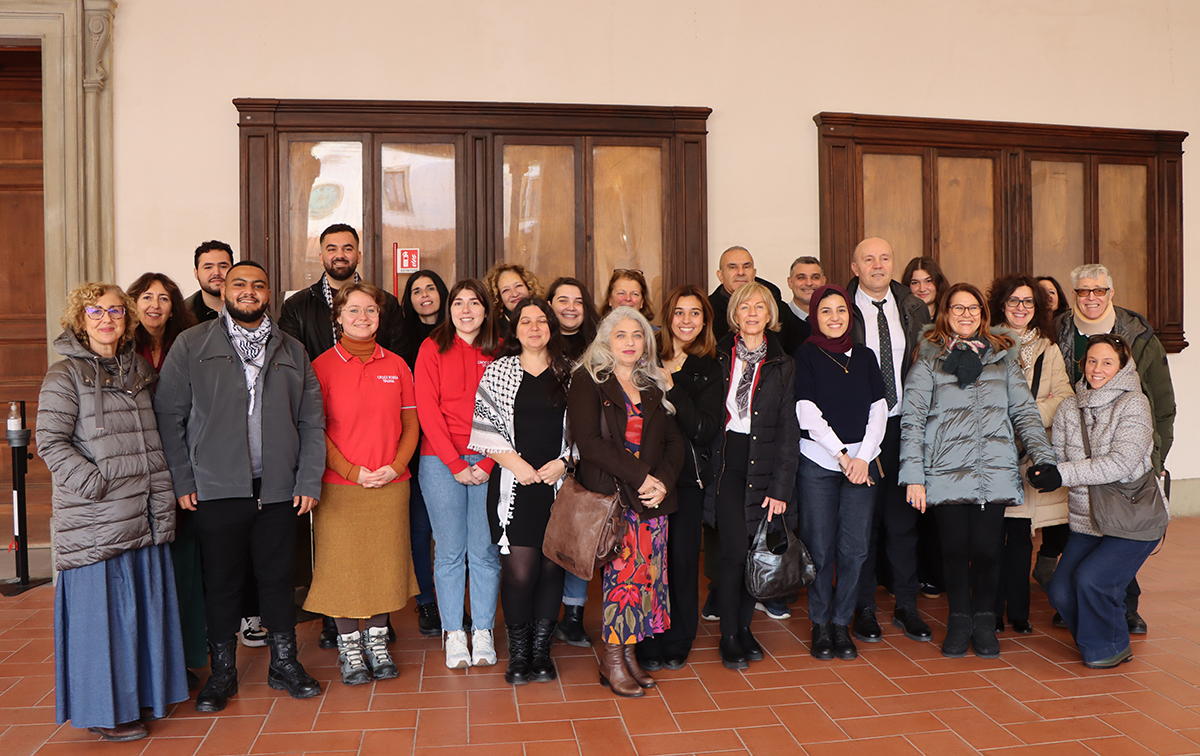
The students shared their personal stories and expressed their gratitude to the University for the support they received. In addition to Aya, who arrived last October to enrol in the Master’s Degree Course in Exploration and Applied Geophysics, the University welcomed Ahmed, enrolled in the Master’s Degree Course in Economics; Muawiya, enrolled in the Master’s Degree Course in Data Science and Business Informatics; Mohammed, enrolled in the International Programme for Humanities Performing Arts and Communication; and Nabaa, enrolled in the Master’s Degree Course in Sciences for Peace.
The five Palestinian students arrived in Pisa through various international cooperation initiatives and university corridors promoted or supported by the University of Pisa. Two students were selected under an agreement signed between the University of Pisa and the Italian Red Cross. Two others were admitted through the IUPALS – Italian Universities for Palestinian Students project, coordinated by the CRUI (the Conference of Italian University Rectors) in cooperation with the Ministry of Foreign Affairs and International Cooperation and the Ministry of Universities and Research, with the support of the Italian Consulate in Jerusalem. Additional support came from initiatives promoted by civil society networks and associations, which enabled the activation of university corridors and the provision of financial contributions to support the right to education.
“Through initiatives such as this,” said Rector Riccardo Zucchi, “the University of Pisa reaffirms its commitment to implementing the principles of peace, sustainability and social responsibility, which form an integral part of our Statute. By welcoming students from conflict-affected regions, we are defending the right to higher education and offering them real opportunities for growth and for the future. At the same time, we are reaffirming the role of the university as a space for dialogue, knowledge production and coexistence among different cultures. This contributes to building a fairer and more inclusive society. The presence of these students provides our university, founded on respect for and appreciation of all cultures, with a tangible opportunity for cultural and human enrichment”.
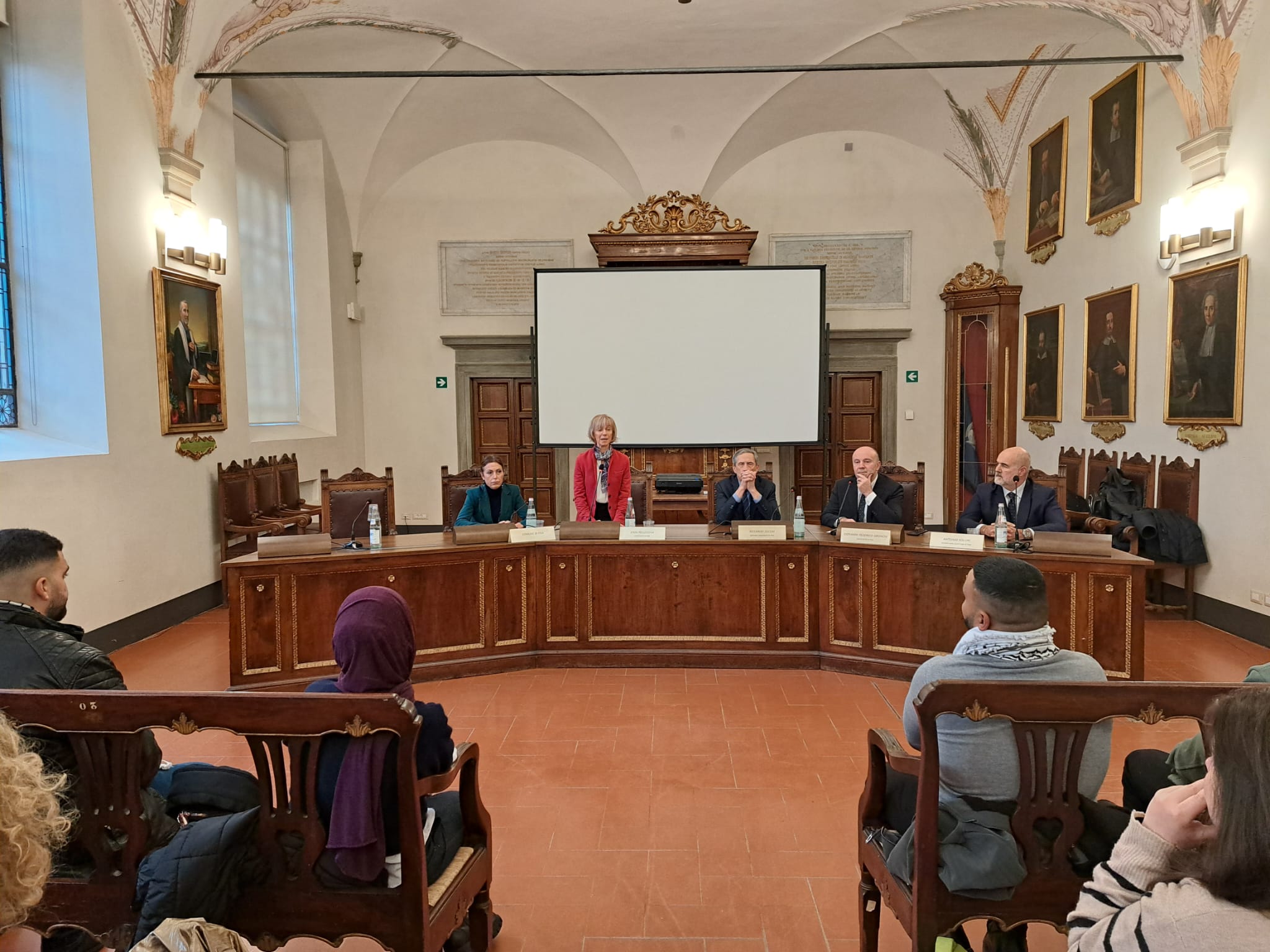
Vice-Rector Enza Pellecchia also spoke about the broader significance of the initiative:
“With the arrival of these first students, we have kept the promise we made to our university community to support the right to education of young Palestinians. The journey that brought them to Pisa was long and emotionally significant for all of us. As we gradually moved beyond the generic definition of ‘Palestinian students’ and came to know their names, faces and personal details — and began corresponding with them — we felt our bond with them, and our responsibility to ensure the success of this initiative grows stronger. They express gratitude to us, but it is we who thank them, because they allow us to remain human.”
“From April 2024 onwards, the University of Pisa has strengthened its commitment to developing collaborations and participating in initiatives aimed at activating university corridors for Palestine,” said Vice-Rector Giovanni Federico Gronchi. “This initiative is part of the University’s broader policy of interventions and initiatives, designed to provide concrete support to students from conflict-affected areas, facilitate access to higher education and promote inclusion, international cooperation and the protection of the right to study.”
The ceremony at the Palazzo della Sapienza was therefore not only a moment of welcome, but also a tangible sign of the University of Pisa’s commitment and responsibility to promote the right to education as a fundamental tool for peace and international cooperation. The initiative also benefited from the support of the Fondazione Lasciti dell’Ateneo and DSU Toscana. The Language Centre of the University of Pisa (CLI) will provide Italian language courses to help the five students integrate into their new academic environment.