

A team of engineers, physicists and chemists from the University of Pisa, in collaboration with the Wuhan University of Science and Technology (China), has developed a new approach to the production of two-dimensional transistors that improves their performance while remaining compatible with industrial manufacturing processes, thereby facilitating future technology transfer once the technology reaches maturity. The research has been published in the May issue of Nature Electronics.
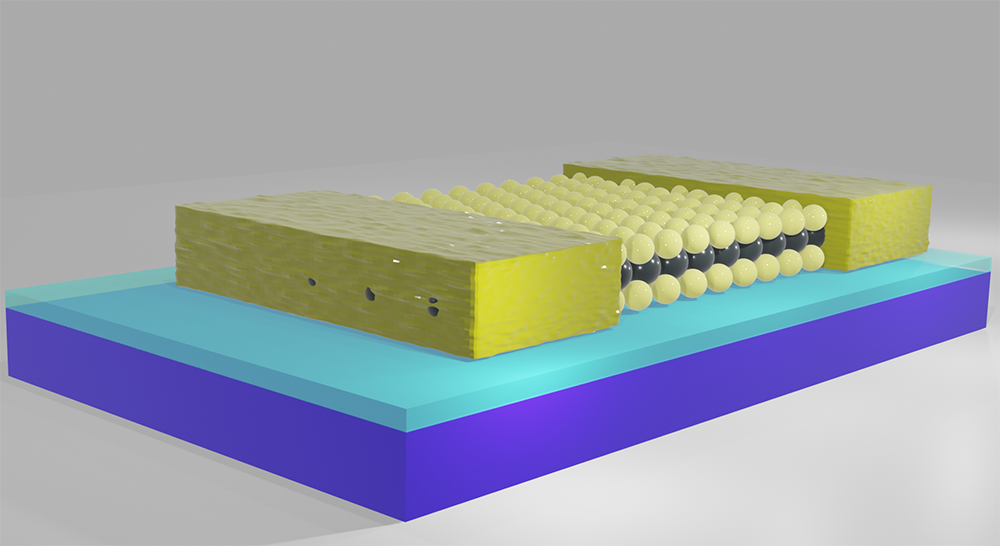
“Transistors,” explains Gianluca Fiori, Professor of Electronics at the Department of Information Engineering of the University of Pisa, “are the fundamental building blocks of the electronic circuits that make up our computers. For many years, microelectronics research has been seeking solutions capable of surpassing the performance of silicon-based devices, focusing on two-dimensional semiconductors, which are only one or two atoms thick. These materials make it possible to miniaturise transistors and therefore increase their number within computers, resulting in greater speed and efficiency. However, the production process of two-dimensional transistors still faces significant challenges due to defects that limit their performance.”
“In this study, we propose a method to improve the quality of two-dimensional materials,” continues Damiano Marian, Professor of Condensed Matter Physics at the Department of Physics of the University of Pisa, “by using oxygen to enhance transistor performance. This represents another concrete step towards the development of computers based on two-dimensional devices. In Pisa, we worked on the theoretical development of the system, while researchers at the University of Wuhan carried out the experimental work. Through first-principles simulations, capable of modelling the behaviour of matter at the atomic level, we were able to explain the experimental observations, demonstrating how oxygen can ‘repair’ some of the defects naturally present in two-dimensional materials, effectively ‘healing’ the material that will be used to build transistors.”
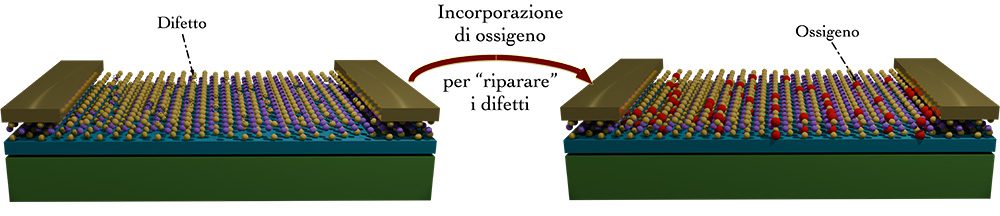
“Indeed,” adds Teresa Cusati, theoretical chemist and technologist at the Department of Information Engineering of the University of Pisa, “these defects, which consist of missing atoms within the structure, normally hinder the movement of electrical charges and reduce device performance. By introducing oxygen atoms into the material in a controlled way, it was possible to neutralise a large proportion of these defects, facilitating charge transport within the transistor and improving the interface between the material and the metal contacts. Thanks to this approach, which is compatible with industrial fabrication processes, these transistors achieve electrical transport properties approximately three times greater than those of untreated devices.”