


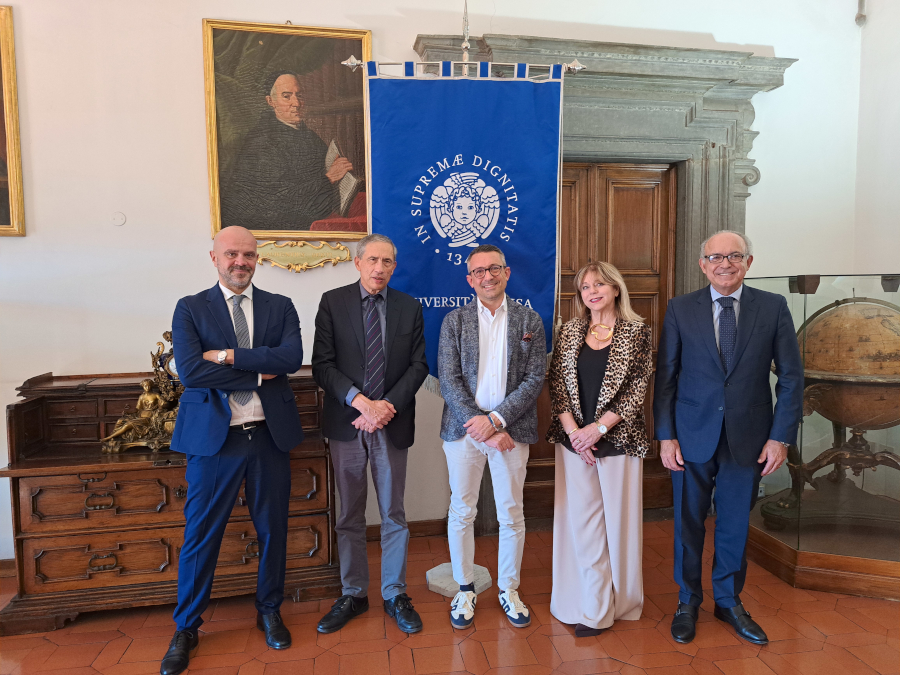
Putting research at the service of the islands of the Tuscan Archipelago to protect their natural resources and historical and cultural heritage, promote sustainable tourism and create new educational and employment opportunities for young people. These are the objectives of a memorandum of understanding between the University of Pisa and the Tuscan Archipelago National Park, signed on 3 November by Rector Riccardo Zucchi and Park President Matteo Arcenni.
The three-year collaboration aims to turn the Archipelago into a testing ground for research and real-world solutions, bringing together the University’s expertise with the needs of the Park and island communities. The University’s representatives will be Marco Macchia, Delegate for Relations with the Local Area, and Alessio Cavicchi, Delegate for the Promotion and Coordination of Circle U. Alliance activities. The Park will be represented by its Director and Giovanna Amorosi of the Education and Promotion Office.
Planned activities include summer schools, scholarships, seminar series and internships, providing opportunities for training and field research. Areas of collaboration range from natural, biological and geological sciences to agriculture and forestry, from archaeology, history and art to engineering and computer science. Particular attention will be paid to tourism in its various forms, including nature-based tourism, cultural tourism, food and wine tourism, and scientific tourism.
The agreement also provides for the involvement of local communities, with the aim of combining environmental protection with economic and social development, fostering entrepreneurship, employment and inclusion. One of the first projects identified under the agreement is an initiative to support mariculture on the island of Capraia, where the sector is currently facing the effects of climate change and the spread of a bacterium causing the death of gilthead seabream and European seabass. The aim would be to draw on the University’s scientific expertise to find solutions to protect an activity that is important to the island’s economy.

“The relationship with the local area is vital for the University and is sustained through dialogue and collaboration,” said Rector Riccardo Zucchi. “In this context, our collaboration with the Tuscan Archipelago National Park is particularly valuable from a scientific perspective and offers opportunities for mutual exchange: research provides the Park with knowledge and expertise, while the Park offers an environment in which to address real-world problems and test practical solutions.
“Thanks to the involvement of Circle U., the European university alliance of which Pisa is a member, this collaboration could also take on an international dimension, bringing students and researchers from partner universities to the Archipelago. One of the most interesting opportunities lies in Living Labs, field-based research and training experiences in which participants work closely with local communities to address local challenges and jointly identify possible solutions. This model combines education, research and participation and could help turn the Archipelago into a centre for innovation and sustainability open to Europe.”
“The signing of this memorandum of understanding marks a milestone for the future of our Archipelago,” added the President of the Park, Matteo Arcenni. “The collaboration with the University of Pisa, an institution of academic and scientific excellence in our region, is a cornerstone of our strategy to combine high-level research with practical biodiversity conservation. Our island ecosystems are unique natural laboratories, extraordinary yet extremely fragile. Strengthening this partnership means putting science at the service of flora and fauna conservation, the protection of our marine and terrestrial environments, and the enhancement of local agrobiodiversity.”
Arcenni continued: “I would like to thank the Rector for sharing this vision from the outset: joining forces with the University of Pisa will enable us to develop innovative monitoring projects, promote sustainability and offer young researchers a research setting unlike any other in the world. This marks the beginning of an even more structured and effective phase of cooperation for the benefit of the entire community and the environment.”