

LAVA — Literary Atlas of Volcanic and Seismic Activities — has arrived: the first digital platform that allows users to explore centuries of narratives devoted to earthquakes and eruptions through interactive maps and thematic pathways. A true literary atlas of a trembling planet, built through the convergence of geological studies and humanities research. The project brings to a broad public this narrative heritage, often confined to specialists, offering an immersive experience: users can discover how major natural disasters have been recounted across different eras and cultures, in forms that weave together memory, emotion and observation of the natural world.
LAVA will be officially launched during the international conference “The Awakening of Enceladus. A Transdisciplinary Inquiry into Geological Risk and Disaster”, held at the University of Pisa from 17 to 19 December as part of the PRISMA project (Pondering Risk and Imagining Resilience). Coordinated by Professor Biancamaria Rizzardi of the University of Pisa and funded through the PNRR Return call for research on earthquakes and eruptions, the project investigates how societies construct narratives of disasters and how these narratives influence risk perception and forms of resilience.
The Atlas
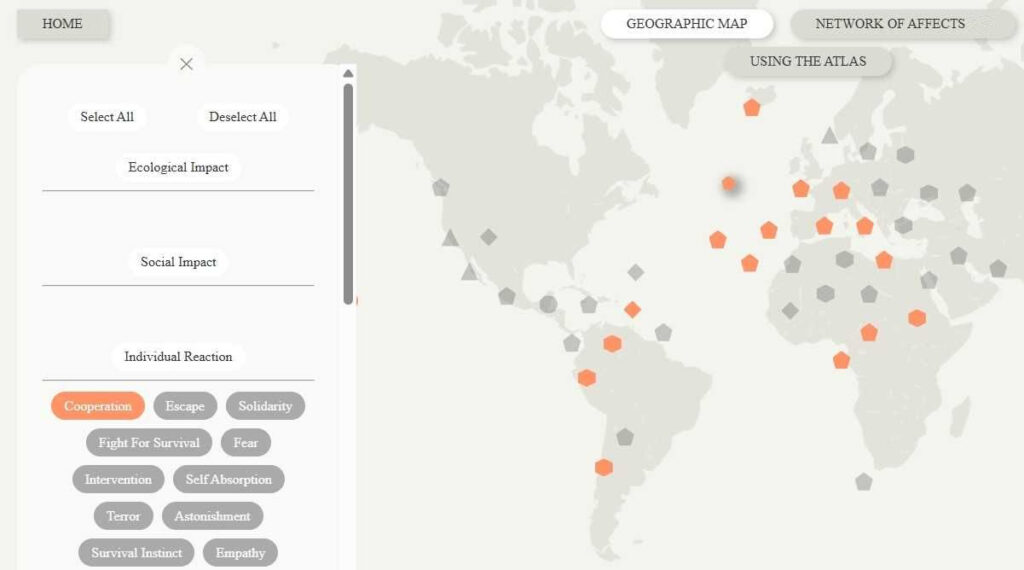
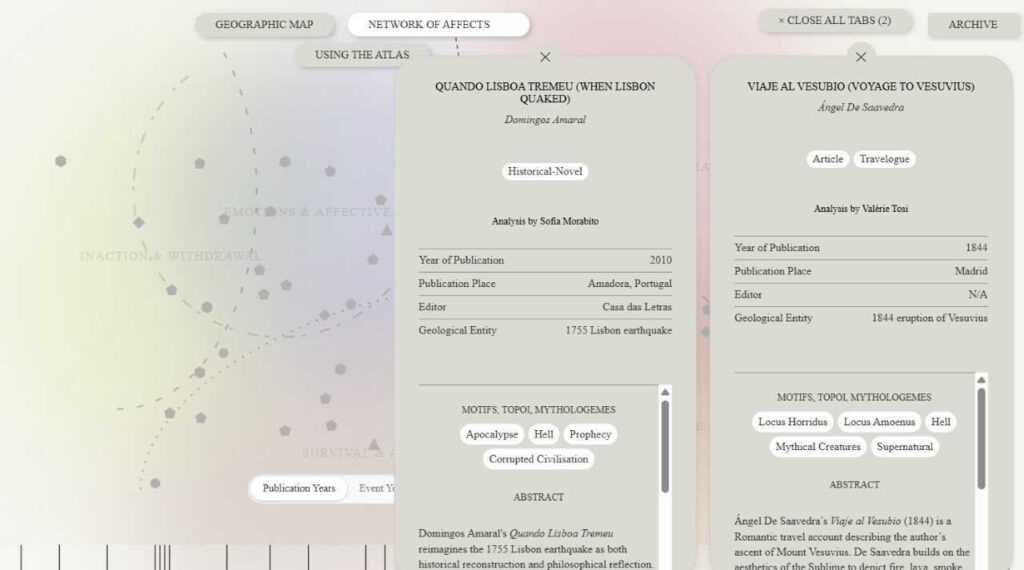
The interactive LAVA Atlas is the heart of the project: a visual and relational space that translates the research process into digital form. Here, literary works are not mere testimonies but become laboratories of emotion and thought — places where individuals and communities process fear, loss and reconstruction. Each node in the atlas connects real events such as earthquakes, eruptions and disaster sites with cultural symbols and metaphors, historical and social consequences, and the diverse philosophical and poetic languages through which risk, trauma and renewal are narrated. The result is a narrative ecosystem that makes the complexity of human responses to extreme events accessible and shareable.
The platform will be presented in its final version in Pisa on 18 December at 3:15 p.m. in the Auditorium of Palazzo Blu and will be available online from that moment onwards.
The Awakening of Enceladus
The conference, which brings together scientists, writers and artists, will offer three keynote lectures, literary conversations and a lecture-performance, alongside six thematic sessions dedicated to major metaphors of catastrophe — Gaia, Prometheus, Mnemosyne, Typhon, Atlas, Hephaestus and Enceladus — and to the ways in which science, culture and imagination intersect. David Alexander (London) will explore disaster iconography in the history of Western art; Frank Westerman (Netherlands) will reconstruct the stories surrounding the tragedy of Lake Nyos in Cameroon; and Isak Winkel Holm (Copenhagen) will analyse the “prophetic noir” in Kierkegaard’s work in light of the contemporary climate crisis. The programme will also include the lecture-performance Sono una frana by Matteo Belli.
The conference will be enriched by contributions from authors such as Esther Kinsky (Bonn), who in her novel Rombo links the memory of the Friuli earthquake to the landscape and imagination of the affected community, and Elleke Boehmer (Oxford). The thematic sessions will explore topics ranging from the psychological perception of risk to collective memory, from media and film narratives to the new frontiers of computational linguistics applied to volcanology and to narratives of the Anthropocene.
“I am proud to have coordinated a project which, thanks to scholars from Pisa and from national and international universities, has carried out research that interweaves scientific and humanistic knowledge, reinforcing a key idea of the new millennium: knowledge without boundaries,” says Rizzardi. “The atlas is not the endpoint of this project but a stage that must be pursued and expanded with constant commitment in schools, universities and research centres. Today more than ever we must direct our attention to issues related to environmental risk.
The PRISMA project invites us to see risk as a shared narrative, to transform the memory of catastrophe into knowledge — and knowledge into care.”
“On 25 June 1994, near San Benedetto Val di Sambro, Bologna, Monte Galletto collapsed,” recounts Matteo Belli. “Twenty years later, I was asked to tell the story through a short theatrical piece. The questions that immediately appeared essential were: what is a landslide? Is it a mountain? What remains of it? How does a mountain feel when it collapses? What does it experience? What does it think? How does it live the transition between before and after, between still being and no longer being? And last but not least: can giving life to things that are not human help us understand the reasons behind what we call the ‘inanimate’ world — a world we often ignore, denying it attention, respect and care, until it presents us with the consequences of our neglect?”
Side events
To coincide with the opening of the international conference The Awakening of Enceladus: A Transdisciplinary Inquiry into Geological Risk and Disaster, the University Library System is presenting an exhibition curated by Laura Gigli, Cinzia Romagnoli and Elena Franchini.
The exhibition features a selection of works from the University Library System’s collections, including Pliny’s Naturalis Historia (1539) and Landino’s 1484 commentary on the Divine Comedy, alongside other literary and scientific sources, with works — among others — by Voltaire and Humboldt. A dedicated section focuses on local seismic events, such as the 1846 Tuscany earthquake, while the exhibition concludes with a selection of modern volumes on the theme, available for consultation by the public.
After its presentation on 17 December, the exhibition will be open from 18 December to 30 January at the Library of Italian and Romance Studies, Polo 6 (closed 24 December – 6 January), Monday to Friday, 9:00 am–8:00 pm, free entry.
Credits
From an IT and graphic perspective, LAVA was developed by Henry Albert (Project Lead), Alice Bisio (Project Manager), Matteo Bettini (Art Director) and Federico Poni (Programmer) of Chimera. Chimera is a data visualisation studio that transforms academic research into digital and multimedia forms, connecting academic and digital cultures through maps, essays and interfaces that give research spatial and narrative depth.