


A revolutionary green technique for restoring works of art has made its way from space to Earth. Atomic oxygen, a gas found in the upper layers of the atmosphere and known for its ability to corrode spacecraft materials, can now be used for the first time in conservation laboratories to safely clean even the most fragile surfaces without damaging them. This is the result of MOXY, a European project which comes to an end in 2026 after four years of research. Three prototypes have been developed: one is at the University of Pisa, while the other two are in Ghent and Eindhoven.
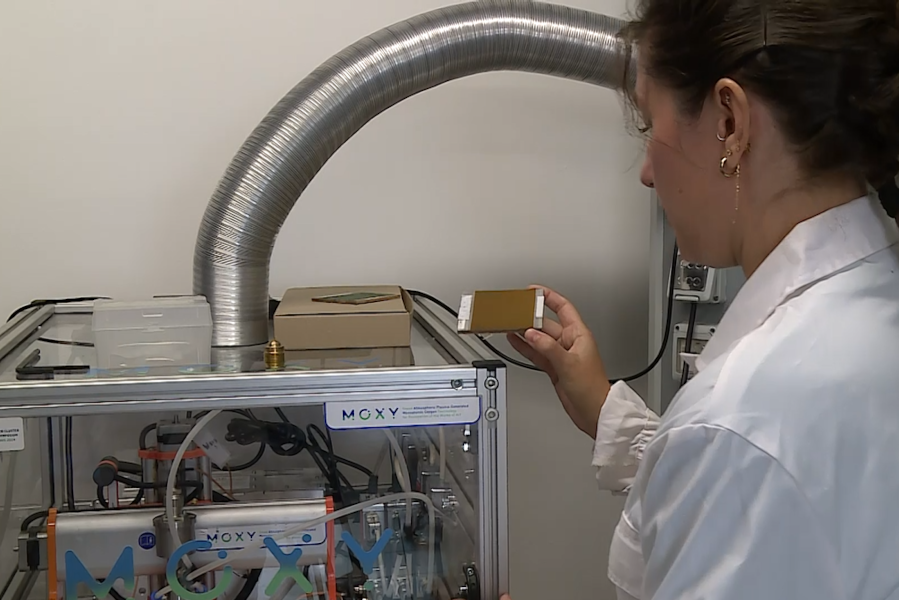
“The idea behind the project is linked to Bathtub, a famous painting by Andy Warhol that was damaged with lipstick. In the 1980s, two NASA scientists, Sharon Rutledge Miller and Bruce Banks, managed to clean it using atomic oxygen without compromising the work,” explains Ilaria Bonaduce, Professor in the Department of Chemistry and Industrial Chemistry at the University of Pisa and head of MOXY for the University. “That technique, however, required complex equipment and vacuum chambers. With MOXY, for the first time, we have succeeded in making it usable at ambient pressure in a standard conservation laboratory. The prototype in our laboratories can direct a flow of atomic oxygen straight onto the work of art. The cleaning process is contactless, requiring no rubbing, wetting or application of solvents.”
MOXY thus opens up an entirely new and more sustainable approach to cultural heritage conservation. The cleaning process leaves no residues and produces no contaminated materials requiring disposal. Tests have been carried out on plaster and stone, oil and tempera paintings, textiles, paper, coatings and plastics.
The most striking results concern soot and black deposits caused by pollution, smoke or fires. These substances are particularly difficult to remove using traditional methods, which generally require sponges, tools, water or solvents. Atomic oxygen, by contrast, acts on the carbonaceous deposits, converting them into carbon dioxide without leaving any residue. Tests have also been conducted on the whitish films that can appear on modern paintings and on marks left by acts of vandalism.
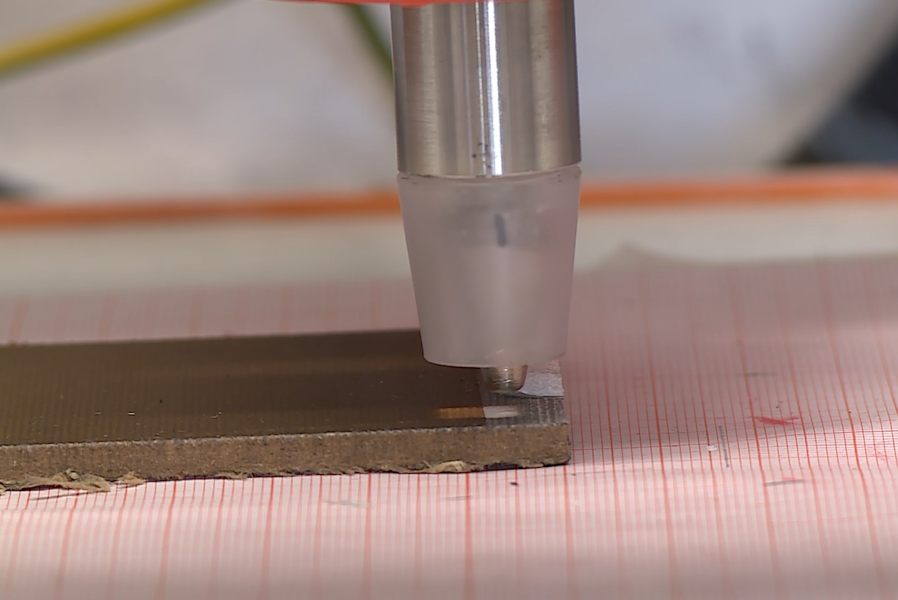
“It is remarkable: it takes only a few moments to see the black deposit disappear from the surface,” says Bonaduce. “The system does not replace the techniques already used in conservation but provides an entirely new tool. In some cases, it can be used on its own; in others, it can be combined with traditional methods. On tarnished silver, for example, it modifies the patina, making it easier to remove with water. The technology is still at an early stage, but it could provide a solution to cleaning problems that have until now been extremely difficult to address.”
The results of MOXY will be presented in Pisa on 6 October 2026 during the international symposium “Science as a Driver of Green Innovation: Advancing Materials Research and Practice in Cultural Heritage Conservation”.
Funded by the Horizon Europe programme under grant agreement 101061336, MOXY ran from 2022 to 2026 and was coordinated by Ghent University. The University of Pisa research team, the only Italian partner in the international consortium, includes Ilaria Bonaduce, Celia Duce, Ilaria Degano, Alessia Andreotti, Silvia Pizzimenti, Erika Ribechini and Jacopo La Nasa.