


What does it mean to build an economy when access to land, water, markets and even freedom of movement is severely constrained? And how can economic initiatives become not only a means of survival, but also a way of strengthening communities and their capacity to shape their own future?
These questions were at the heart of the Circle U. Open Conversation “Democracy, Gender and the Social and Solidarity Economy in Palestine”, held at the University of Pisa on 29 September. Promoted by the University’s Interdisciplinary Centre for Peace Studies (CISP), the event brought together academics and civil society representatives from Palestine and Italy and was also open online to the wider Circle U. community.
The event took place during the visit to Italy of a Palestinian delegation involved in “IBTKAR for Social Change”, a cooperation project led by Oxfam Italia, with COSPE among its partners, focusing on social and solidarity economy, financial inclusion and access to resources in the West Bank, East Jerusalem and Gaza.
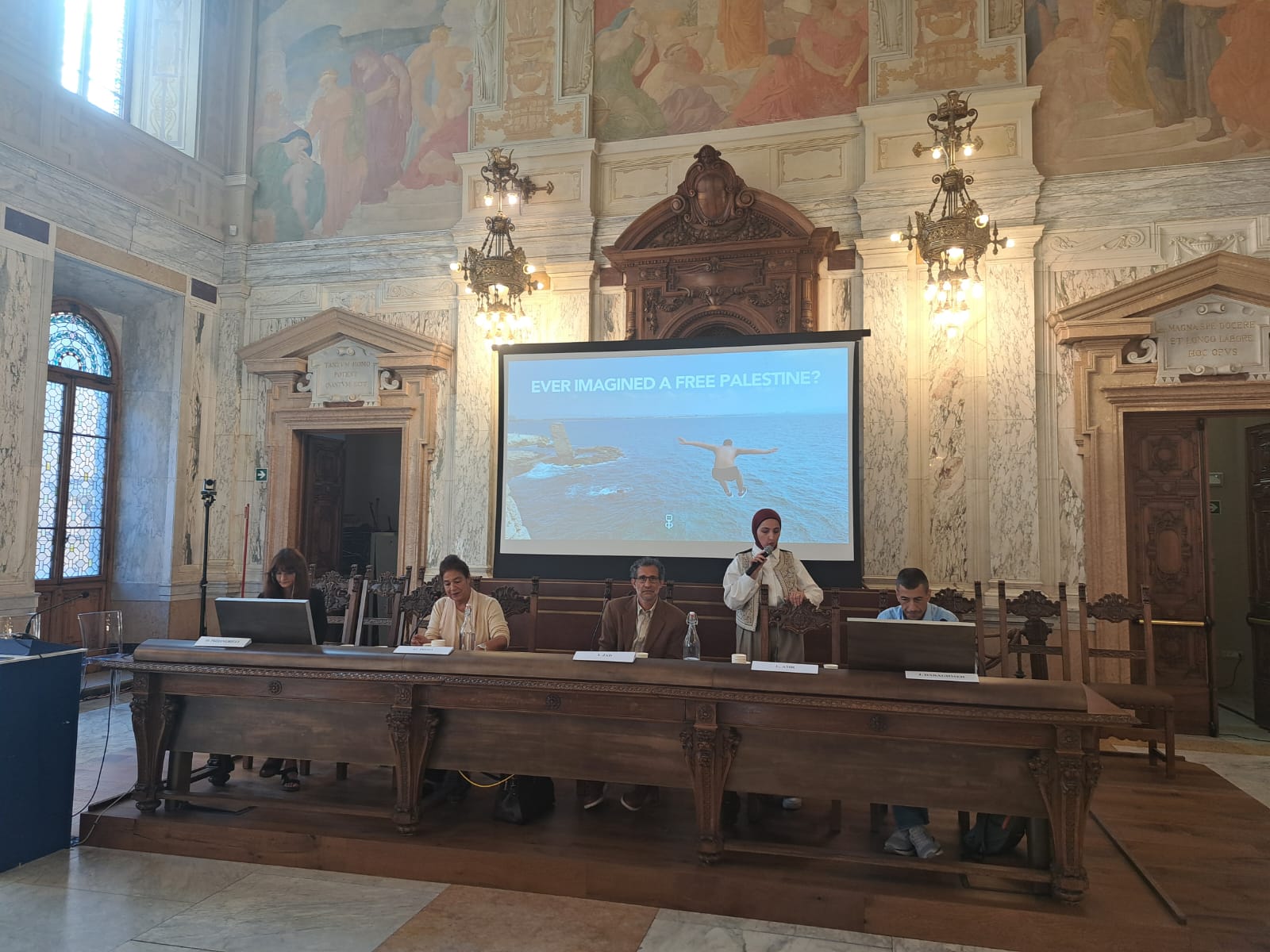
Speakers included Islah Jad, Associate Professor at Birzeit University and Board Member of the Bisan Center for Research and Development; Lama Amr, Executive Director of BuildPalestine; Jamil Daraghmeh, COSPE Coordinator for Economic Development; and Debora Angeli from COSPE Italia. The conversation was opened by Alessio Cavicchi, Rector’s Delegate for the Circle U. Alliance, and moderated by Odetta Pizzingrilli, researcher at the University of Pisa.
A recurring concept throughout the conversation was sumud, an Arabic term expressing resilience, perseverance and the determination to remain. During the discussion, however, sumud emerged as something more than the capacity to endure difficult circumstances: it was presented as the ability to remain connected to one’s land and community, to organise collectively and to continue creating the conditions for a different future.
This perspective was particularly evident in the contribution of Lama Amr, Executive Director of BuildPalestine, an organisation supporting Palestinian social entrepreneurs. She described how one of the first questions BuildPalestine asks the young people it works with is whether they have ever imagined a free Palestine. According to Amr, the question itself can be difficult to answer after years of living within severe constraints. The organisation therefore works not only to encourage people to imagine a different future, but also to turn that imagination into concrete action.
Amr presented several examples of social enterprises and grassroots initiatives responding directly to the needs of Palestinian communities. They range from smart water-management solutions designed to reduce water loss, to community spaces providing educational opportunities for children in areas affected by movement restrictions, and projects helping women and local producers reach markets outside Palestine.
Among the initiatives presented was the Gaza Education Hub, which has created spaces where students and remote workers can access electricity, internet connections and a place to continue studying and working despite repeated displacement. Another example was Hakini, a mental-health technology initiative that has developed psychological support for people in Gaza and worked on approaches adapted to the unprecedented conditions experienced there.
The discussion also highlighted the specific role that women can play in reshaping the Palestinian economy. Jamil Daraghmeh, COSPE Coordinator for Economic Development, described an economy deeply affected by unemployment, movement restrictions and limited access to resources and markets. Within this context, he pointed to women’s economic participation as an important area of potential development, noting how women have increasingly taken on income-generating roles and supported their families since October 2023.
Rather than focusing exclusively on the growth of individual businesses, the speakers stressed the importance of strengthening local economic ecosystems and creating models capable of operating in fragmented territories. In this perspective, small-scale and replicable initiatives, cooperatives, social enterprises and community-based projects can contribute to keeping resources, skills and decision-making capacity within communities.
The Open Conversation brought these experiences into dialogue with broader questions of democratic participation, gender equality and socio-economic rights. It also explored the role universities and civil society organisations can play through socially engaged research and international cooperation.