


From 15 to 18 September 2026, the University of Pisa hosted the Pisa stage of the WP5 Staff Training of BASE (Bologna for Science Education in Palestine and Jordan), the Erasmus+ Capacity Building in Higher Education project coordinated by An-Najah National University in Nablus, Palestine. At the University of Pisa, the project is coordinated by the International Cooperation, Training and Mobility Programmes Unit, in collaboration with academic staff.
The training marked the transition from the design and accreditation of seven new bachelor’s degree programmes at six universities in Palestine and Jordan to their implementation, with the first students entering the programmes in the academic year 2026-2027.
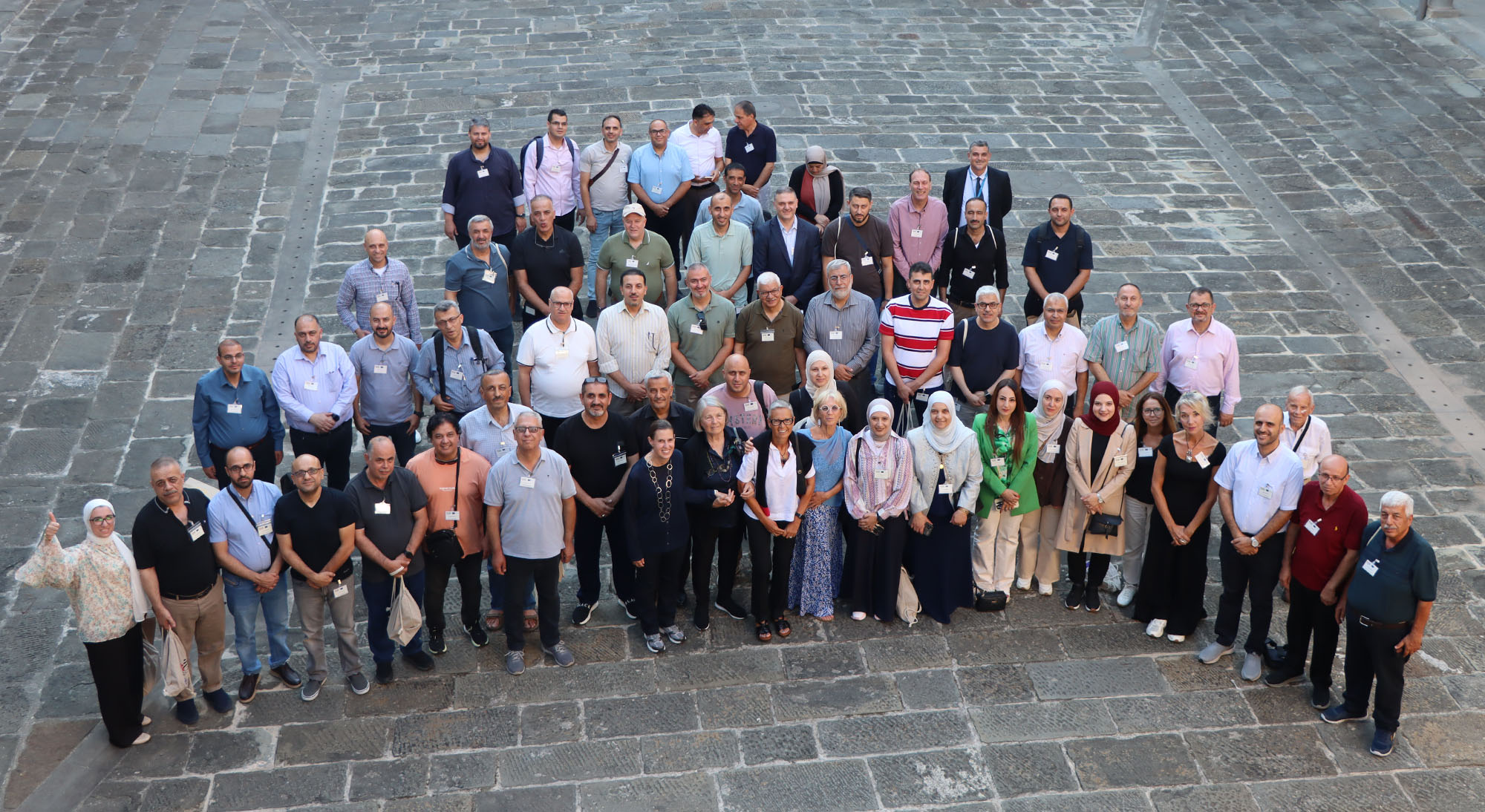
The Pisa programme formed part of a broader training initiative organised jointly by UNIMED – Mediterranean Universities Union and the University of Pisa. The programme began in Rome on 14 September, where UNIMED contributed its experience of higher education cooperation across the Mediterranean, while CIMEA led a session on internationalisation, recognition and mobility.
In Pisa, the focus shifted to the practical implementation of the Bologna Process in teaching and degree programme management. Opening sessions addressed Bologna implementation, ECTS, quality assurance and student-centred learning, with contributions from University of Pisa academics, Bologna and ECTS experts, quality assurance representatives, and staff working in academic affairs and internationalisation.
A central component of the training took place on 16 September, when participants were grouped according to the disciplinary areas of the newly accredited BASE programmes and hosted by corresponding departments of the University of Pisa. The visits were conceived as peer-to-peer exchanges between academics working in the same or related fields, providing an opportunity to compare approaches to teaching, assessment, ECTS, laboratory activities and programme management.
The Department of Chemistry and Industrial Chemistry hosted colleagues from An-Najah National University working on the new BSc in Applied Chemistry. The Department of Physics welcomed academics from Arab American University and Jordan University of Science and Technology involved in the Applied Physics and Technology and Applied Physics programmes. The Department of Computer Science worked with the delegation from Palestine Technical University–Kadoorie on its Computer Science programme. Representatives of the Departments of Pharmacy and Civil and Industrial Engineering met colleagues from the German Jordanian University and Jordan University of Science and Technology working on Pharmaceutical and Chemical Engineering and Chemical Engineering. The delegation from Al-Balqa Applied University, responsible for the new Applied Biological Sciences programme, met representatives of the Department of Biology and of Translational Research and New Surgical and Medical Technologies. The departmental visits were followed by a joint review session in which participants compared experiences across different disciplinary contexts.
The University of Barcelona and the University of Pisa’s Teaching and Learning Centre also contributed to the programme, presenting their work on innovation in university teaching. Sessions addressed active and student-centred learning, service-learning, teaching experimentation and academic staff development, while the final day introduced the Centre, the University’s community of teaching mentors and its special educational projects.
The programme also examined the challenges involved in moving from curriculum design to delivery. A round table brought together experts from Pisa, Bologna, Padua and Sapienza University of Rome to discuss ECTS monitoring, competence-based assessment and staff development. A further session led by University of Pisa academics explored the growing role of artificial intelligence and information technologies in teaching.
The Pisa training represented a further step in the BASE project’s progression from planning to implementation. The seven programmes have been designed by the universities that will deliver them and have received national accreditation in Palestine and Jordan; the training offered academic staff the opportunity to examine European practices and reflect on how they can be adapted to their own institutional and disciplinary contexts.
The initiative also strengthened cooperation across the BASE partnership, bringing together academics, university services, quality assurance structures and national authorities around the shared goal of supporting sustainable, internationally compatible higher education programmes in Palestine and Jordan.