

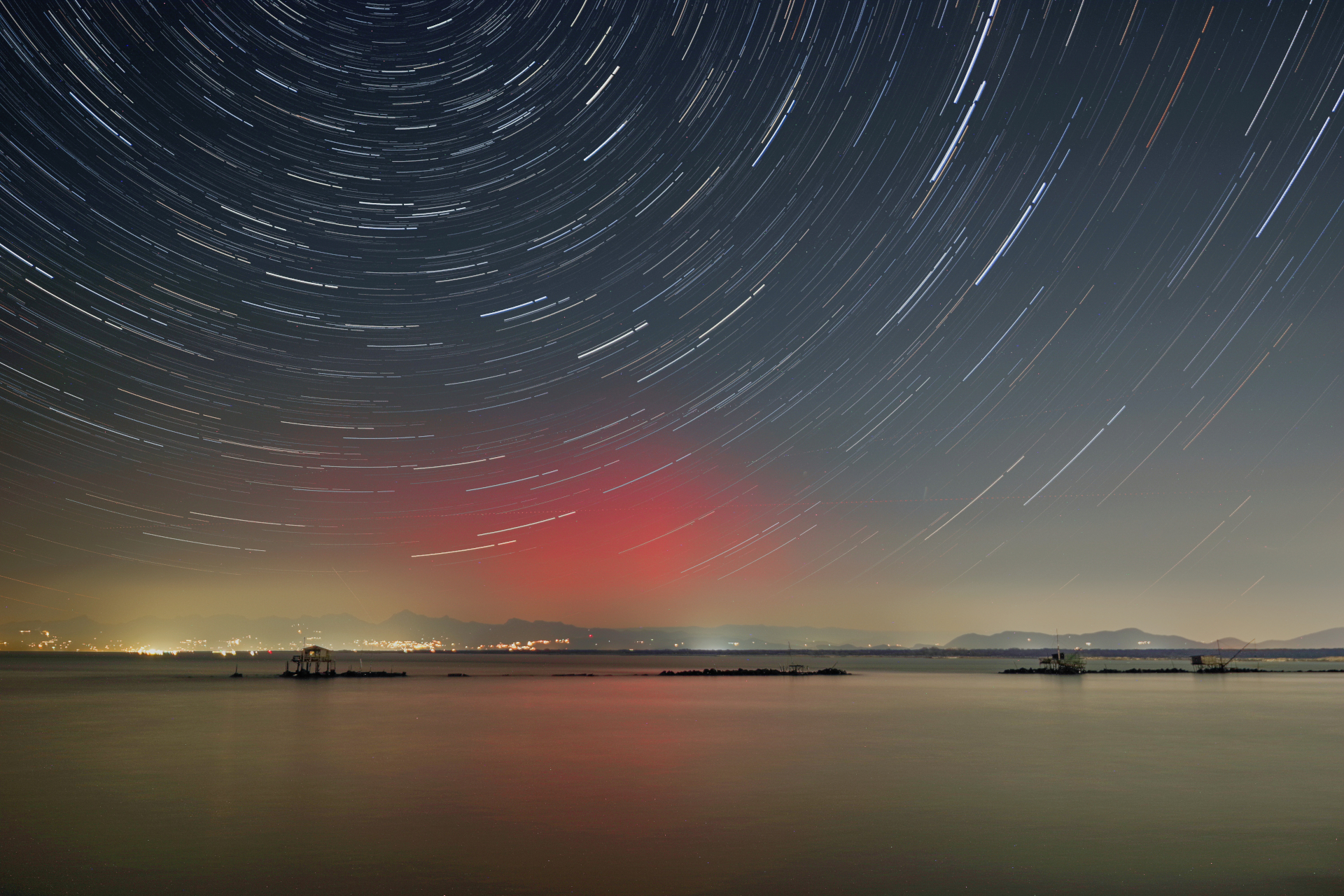
The aurora borealis is a spectacular light display that occurs when several favorable conditions align. It is caused by the interaction between the solar wind and the Earth’s geomagnetic field. This phenomenon typically appears in polar regions, but during periods of intense solar activity, the higher-altitude red portions of the aurora — a color produced by the emission of light from excited oxygen atoms — can also become visible at lower latitudes.
We are pleased to share a stunning image captured by Gashanew Ficini, a student in the Department of Earth Sciences. The photograph, taken from Bocca d’Arno facing the Apuan Alps on January 20, is part of the Department of Earth Sciences’ “Photo of the Week” series, which features geology-related images created by DST staff, and especially by students and PhD candidates.
At the time the photo was taken, the Kp index (a measure of auroral intensity) was around 6.
Photo by Gashanew Ficini (DST student)
Technical details: Pentax K-70 with a 15mm lens.
Stacking of 70 individual exposures, each 30 seconds, f/2.4, ISO 200.