

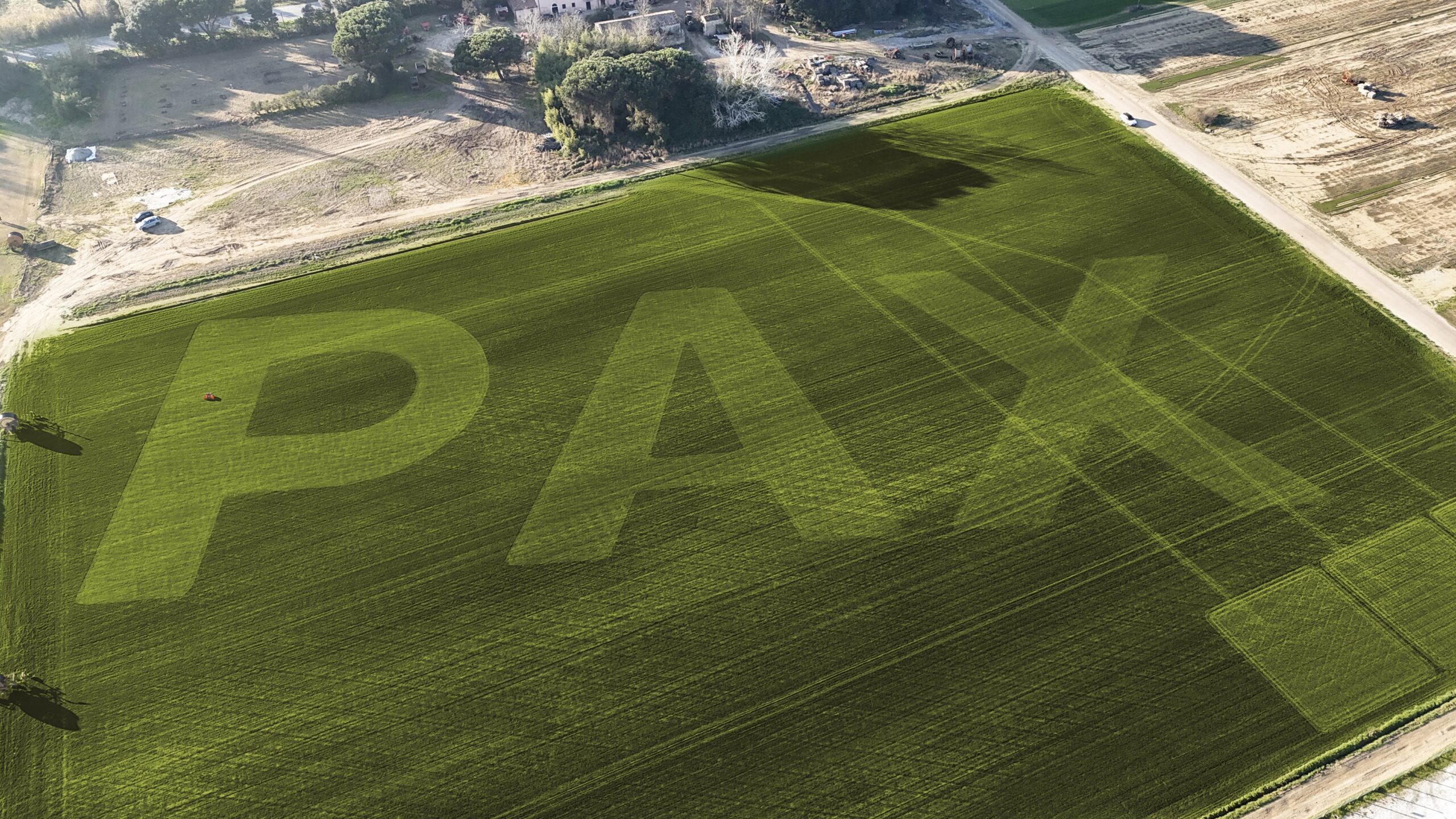
In the countryside of San Piero a Grado, just outside Pisa, an area of approximately three hectares of turfgrass was used as a canvas to create a large symbolic inscription measuring 180 meters and visible even from aircraft during their landing approach at “Galileo Galilei” Airport. The intervention was designed and implemented by the research group CeRTES (Centre for Research on Turfgrass for Environment and Sports) of the University of Pisa.
The Latin word PAX, a universally recognized symbol of peace, balance, and harmony, was chosen for its strong communicative value and its ability to convey a clear and immediate message through a non-invasive approach fully integrated into the surrounding agricultural landscape.
From a technical standpoint, the inscription was produced using a battery-powered autonomous mower using satellite navigation systems. Setting the mowing at two different cutting heights made it possible to create a stable chromatic contrast over time, ensuring that the inscription remains clearly legible both from the ground and from aerial and satellite observation platforms.
The initiative represents a significant applied example of the potential offered by automation technologies in turfgrass management, highlighting how operational precision, environmental sustainability, and visual communication can converge within a single project. The experience also confirms the role of agronomic research in enhancing the landscape through technically advanced, low-impact solutions.
The project was coordinated by Marco Volterrani, with the collaboration of Simone Magni, Giuliano Sciusco, Tommaso Federighi, Marco Fontanelli, Mattia Fontani, Lisa Caturegli, and Maria Giulia Parrinelli. The experimental area was made available by the company Bindi Pratopronto Nord, owned by Marco Bindi.