

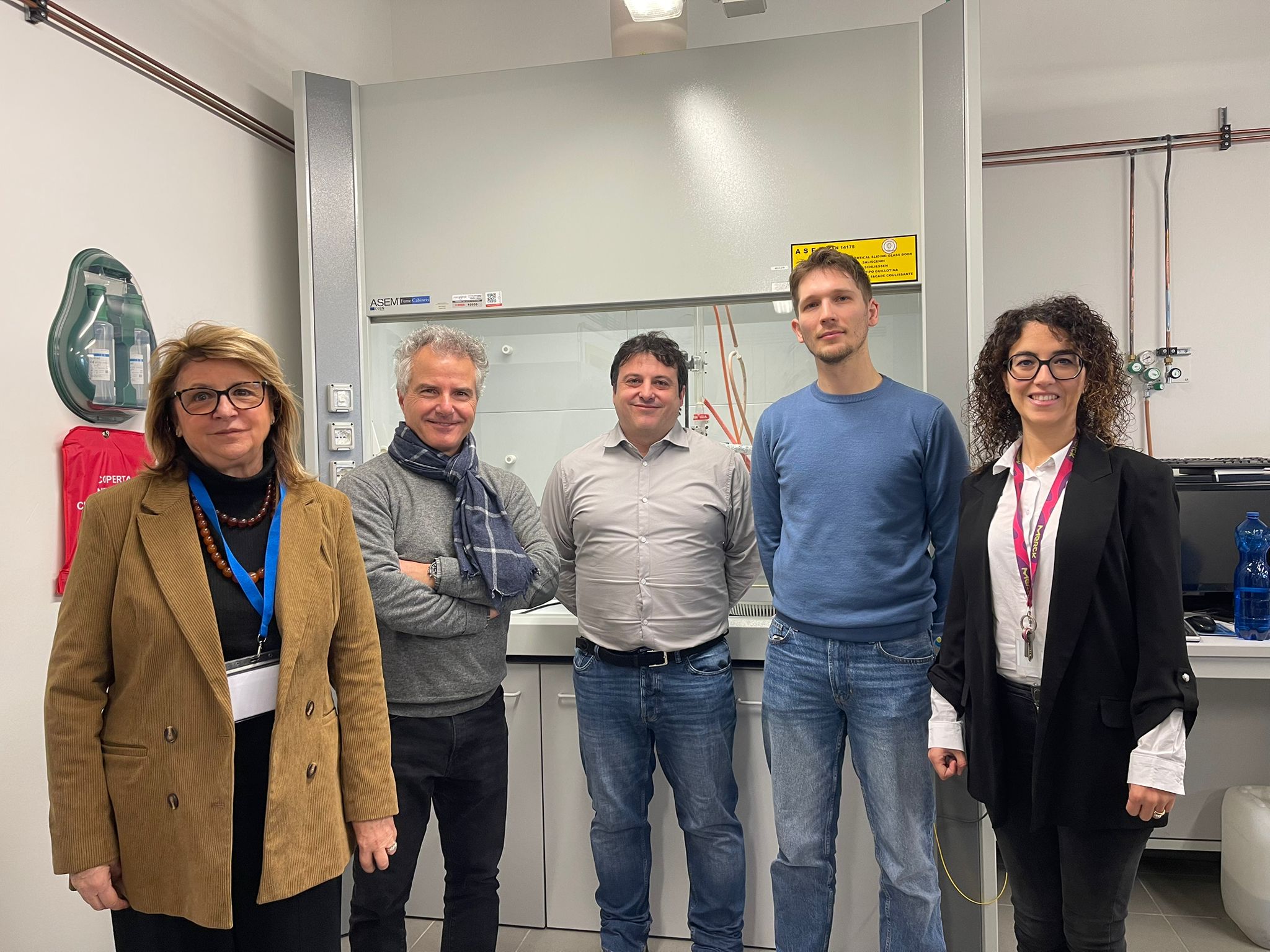
A study conducted at the University of Pisa has come up with an innovative circular economy approach that addresses two of today’s most pressing global challenges: the urgent need for an energy transition to renewable sources, and the growing issue of food waste. The research, published in the “Journal of Environmental Chemical Engineering”, aims to transform one of the most abundant food wastes in the world — bread waste, at almost one million tonnes per year — into a sustainable biofuel. Funded as part of the PNRR NEST project, the study is the result of a collaboration between the Department of Chemistry and Industrial Chemistry (Professor Anna Maria Raspolli Galletti, Dr Sara Fulignati, and Dr Lorenzo Bonaldi) and the Department of Energy, Systems, Territory and Construction Engineering (Professor Stefano Frigo, Dr Marco Francesconi, and Dr Luca Miglino).
This study addresses the sustainable synthesis of ethyl levulinate from waste bread for the first time. Ethyl levulinate is a high-value compound of biological origin that is already known for its applications in the chemical industry and as an oxygenated additive for fuels. The researchers have developed a simple, economical, and easily transferable industrial-scale process using a low-cost catalyst and diluted sulphuric acid while adopting high initial concentrations of biomass. This approach enables more concentrated product streams, reducing separation costs and enhancing the process’s overall efficiency. By optimising parameters such as temperature, reaction time and catalyst quantity, the team achieved a maximum yield of 57% ethyl levulinate, which is a particularly significant result given the waste origin of the raw material.
Although ethyl levulinate has been extensively studied as an oxygenated additive for diesel, this research opens up completely new scenarios. For the first time, the compound has also been tested in petrol engines, mixed with commercial fuel at percentages as high as 40% by volume.
Experimental tests have shown that such mixtures do not significantly alter engine performance and do not require modifications to current internal combustion engines. Conversely, using ethyl levulinate enables pollutant emissions to be reduced and the proportion of fossil fuels in commercial fuels to be decreased.
These results significantly expand the market potential of ethyl levulinate, confirming its status as a versatile, renewable oxygenated additive usable in both diesel and petrol engines.
“The conversion of bread waste into ethyl levulinate is a concrete example of how scientific research and technological innovation can contribute to the development of easily applicable solutions for the production of renewable energy,” the researchers comment. “Reducing food waste and transforming it into alternative biofuels means taking an important step towards more sustainable mobility that can respond to current environmental needs while remaining compatible with existing technologies.”